IT Jobs in Dubai: Skills, Certifications, and Job Search Strategies
Dubai's economy depends on technology. Banks, airlines, hotels, logistics companies, hospitals, retailers and government entities all run systems that need people to build, protect and support them. For job seekers, that creates opportunity, but also noise: advertisements use inflated titles, certificate sellers promise quick results, and candidates struggle to know what employers really want. This guide explains the main kinds of IT roles, the skills that tend to matter, how to think about certifications, and how to build evidence of your ability that goes beyond a CV.
It does not list vacancies or give salary figures, and it cannot predict hiring. Employer requirements change quickly, so check current job descriptions in your target area.
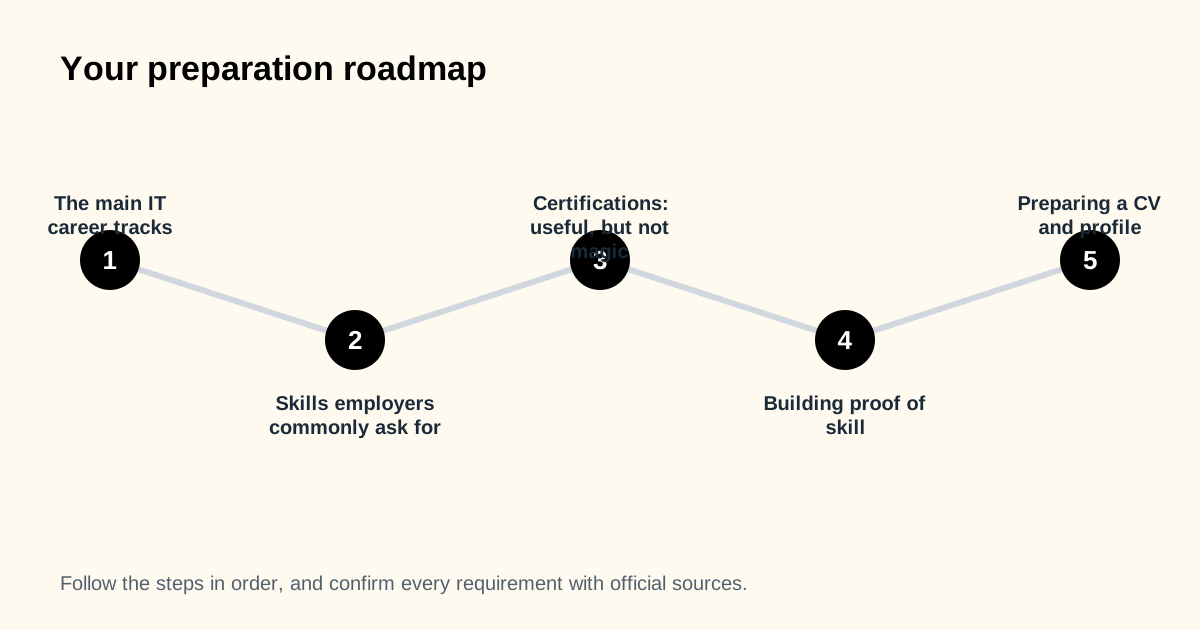
The main IT career tracks
IT is not a single job. Choosing a track early makes your search more focused.
IT support and helpdesk
Support staff solve user problems with computers, accounts, networks and software. The role suits beginners, because it builds broad practical knowledge. Employers look for clear communication, patience and a methodical approach to troubleshooting.
Network and systems administration
Administrators keep servers, networks, backups and user access running. Skills include operating systems, networking basics, monitoring and documentation. This track often follows support experience.
Software development
Developers design and build applications, websites and services. Employers want evidence in the form of projects, a working knowledge of at least one language and the ability to work in a team with version control and testing.
Cybersecurity
Security professionals protect systems and data, monitor threats, respond to incidents and help staff follow safe practices. The field expects strong fundamentals in networking and systems before specialisation.
Data, analytics and cloud
Analysts turn data into reports and decisions, and cloud engineers manage systems hosted on cloud platforms. Employers value practical skills in spreadsheets, databases, query languages and dashboards, as well as understanding of business needs.
Project and business roles
Business analysts, project coordinators and product staff connect technical teams with business goals. Strong writing, planning and stakeholder communication are central.
Skills employers commonly ask for
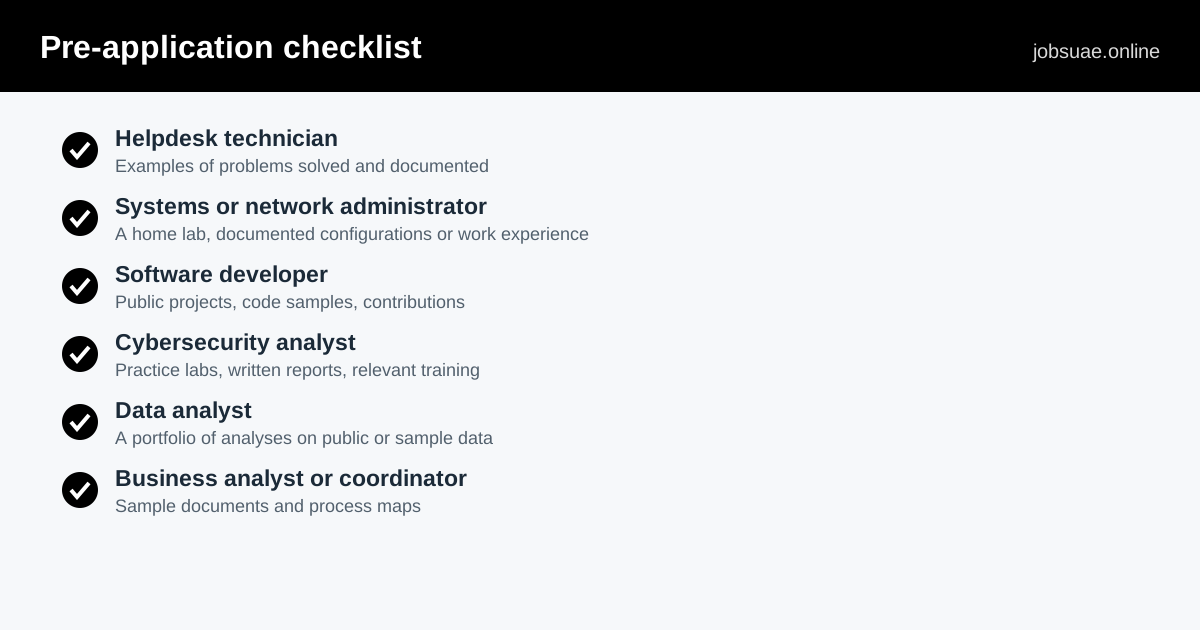
The table below links common IT roles to skills and ways to prove them. It is a general guide.
| Role | Typical skills | Evidence to prepare |
|---|---|---|
| Helpdesk technician | Troubleshooting, user accounts, hardware, communication | Examples of problems solved and documented |
| Systems or network administrator | Operating systems, networking, backups, monitoring | A home lab, documented configurations or work experience |
| Software developer | Programming language, version control, testing | Public projects, code samples, contributions |
| Cybersecurity analyst | Networking, logging, security tools, incident handling | Practice labs, written reports, relevant training |
| Data analyst | Spreadsheets, databases, query language, dashboards | A portfolio of analyses on public or sample data |
| Business analyst or coordinator | Requirements writing, planning, communication | Sample documents and process maps |
Certifications: useful, but not magic
Certifications can show that you have studied a body of knowledge, and many employers mention them in adverts. They rarely replace practical ability. Before paying, check whether the certification is issued by a recognised vendor or professional body, whether it appears in adverts for the roles you want, what the exam and renewal requirements are and how much hands-on practice it includes.
Avoid providers that guarantee jobs, promise to supply exam answers or ask you to pay a recruiter for placement. Such offers are common scams and can harm your reputation. If an employer sponsors training, ask what commitments are attached. Our guide to avoiding recruitment scams lists warning signs that apply to training offers as well.
Building proof of skill
A strong IT candidate can show work. For developers, create a small number of well-explained projects rather than many unfinished ones, and write a short description of the problem, the tools used and what you learned. For support and systems roles, document a home setup such as a small network, virtual machines and a backup plan. For analysts, publish examples using public data, explaining your questions and conclusions in plain language. For security, keep notes from practice labs and write short reports describing what you found and how you would fix it.
Make sure the work is yours, and never copy another person's project or inflate your involvement in a team effort. Interviewers often ask detailed questions, and honesty protects you.
Preparing a CV and profile
An IT CV should be concise and specific. Put a short summary at the top, followed by a skills section grouped by area, such as languages, systems, tools and networking. In your experience section, describe what you built, supported or improved and the scale, using numbers only when accurate. Link to your portfolio if you have one. If your CV needs work, start with our guide to writing a UAE-style CV.
Keep your professional profile consistent with your CV, use a clear photo if you choose to include one and avoid exaggerated titles. Employers often check profiles before interviews.
Searching for IT jobs in Dubai
Use several channels. Employer career pages are the most reliable, so build a list of companies in your field, such as banks, logistics firms, hotels, telecoms and software companies. Reputable job boards and professional networks help with volume, and licensed recruitment agencies place many technical roles. If you are building a search plan, our practical Dubai job-search guide will help. Attend professional events and online communities to learn what employers expect, but confirm any event through official organiser sources.
Read adverts carefully. A role titled "IT manager" may be a helpdesk post in practice, and an advert asking for ten years of experience in tools that are only five years old signals a poorly written requirement. Apply when you meet the core needs, even if you miss some preferred items, but be honest about gaps.
Interview preparation
IT interviews often combine behavioural questions, technical questions and a practical task. Expect to explain a past problem you solved, how you prioritise work, and how you communicate technical issues to non-technical colleagues. Technical tests may include troubleshooting scenarios, short coding tasks, configuration questions or case studies. If you do not know an answer, say what you would check first and how you would find out, because employers value reasoning.
Prepare questions about the team, tools, support hours, on-call expectations and training budget. These show professionalism, and they help you judge whether the job fits you.
A realistic starting path for beginners
If you are new to IT, a sensible route is to begin in support, because it exposes you to many systems at once. In the first months, learn how to diagnose problems step by step: ask the user what changed, reproduce the issue, check the simple causes first and write down the fix. Next, study networking basics such as addressing, DNS and Wi-Fi, and practise with a small home setup. After a year or so, you can choose a direction, such as systems administration, security or cloud, and build a project in that area. Moving this way takes patience, but it gives you evidence of real work, which employers trust more than a long list of course titles.
Mistakes IT candidates often make
Some applicants list dozens of tools they have only seen once, so interviewers probe one and the answer collapses. Others send the same CV to every role, ignoring the stack named in the advert. Many forget to explain results, writing "managed servers" without saying how many, what improved or what they learned. Some buy several certificates in a short time without building any practical experience, which can look like box-ticking. A final mistake is neglecting communication: an engineer who cannot explain a problem simply to a manager will struggle, however strong the technical skill.
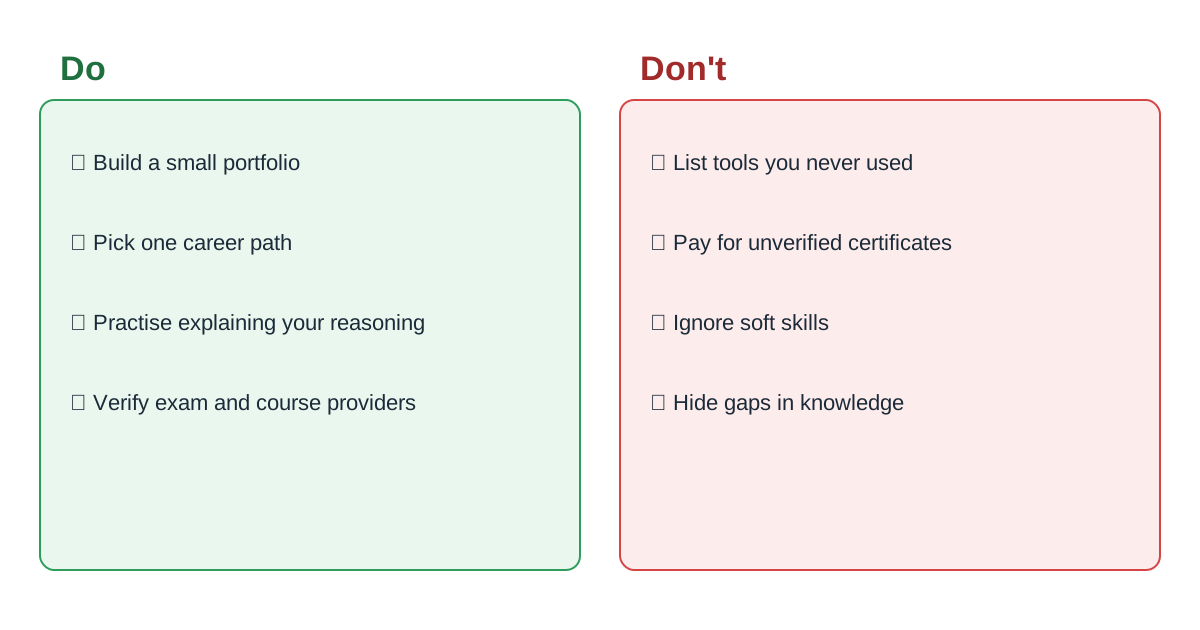
The fix is to keep your skills list short and truthful, tailor each application to the advert, describe outcomes and practise explaining your work aloud.
Ethics, security and professional habits
IT staff often have access to sensitive systems and data. Employers expect confidentiality, honesty and respect for company policy. Never test systems you are not authorised to access, copy company data to personal devices without permission or ignore security procedures. Document your work, communicate incidents quickly and follow change processes. These habits build trust and are often the difference between a junior who is promoted and one who is not.
Contracts and offers
Before you accept, check the job title, duties, working hours, on-call or shift requirements, salary and allowances, probation, notice period and any training or bond conditions. Ask whether the employer will arrange the work permit and confirm it in writing. Do not pay a fee to an employer or recruiter for a job. Check MOHRE's guidance on labour contracts if any term looks unusual.
Build proof, not just a skills list
Employers hiring IT staff look for evidence. A small portfolio, such as a GitHub repository, a documented home lab, or a short write-up of a problem you solved, is more convincing than a long list of tools. For support roles, describe the tickets you handled, the systems you managed and how you reduced repeated issues. For developers, link to projects with a short README explaining what they do.
Match your path to the market
Common paths include help desk and infrastructure, software development, cloud, cybersecurity and data analysis. Pick one and learn it deeply before widening. Certifications can help, but choose recognised vendor programmes and confirm exam costs directly with the provider.
Technical interview preparation
Practise explaining your reasoning aloud, and be ready for a short task. Prepare two stories about fixing a hard problem, and ask the team how they handle on-call work and code review.
Conclusion
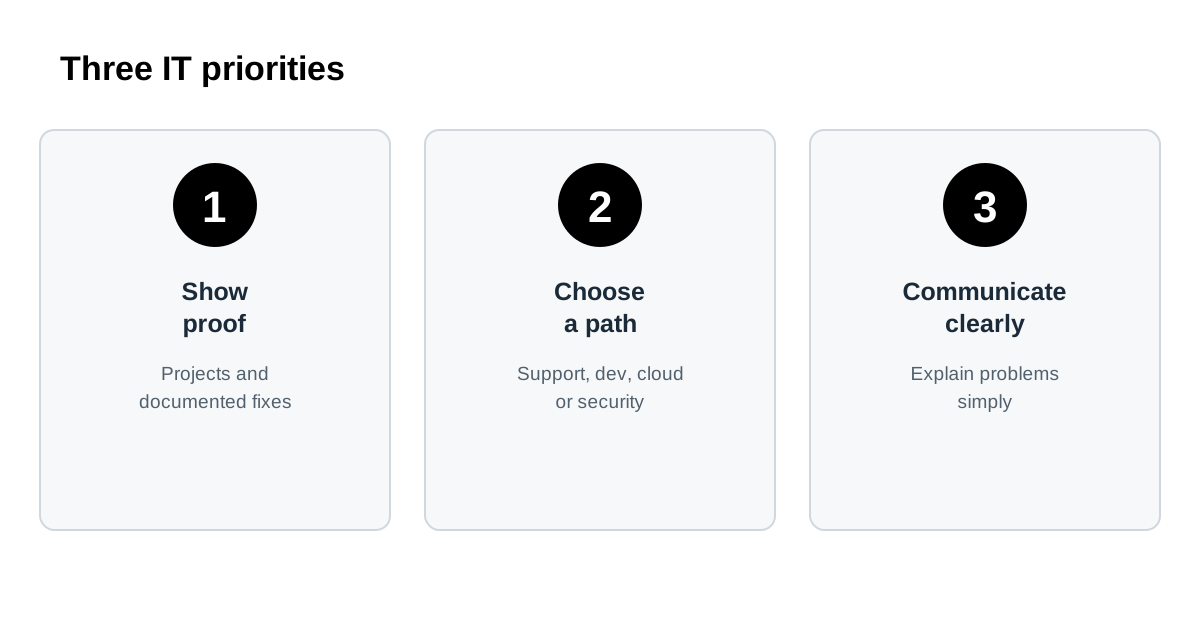
IT jobs in Dubai reward people who keep learning, document their work and communicate clearly. Choose a track that fits your interests, build practical evidence, treat certifications as support rather than shortcuts, and prepare an honest CV and portfolio. Verify the employer, treat certificate sellers with caution and check contract and permit rules on MOHRE and the UAE Government portal. Steady skill-building and careful verification of employers are the most reliable way to progress in the field.
A simple portfolio plan
Pick three small projects: for support, document how you set up and troubleshot a home network; for development, publish a small app with a clear README; for data, analyse a public dataset and explain your findings. Link them in your CV. A short write-up of problem, steps and result shows more than a long skills list.
Frequently asked questions
Which IT path should I start with?
Help desk and infrastructure are common entry points. Choose based on your interests and the adverts you see.
Are certifications required?
They help for some roles, but employers also want practical evidence. Verify providers before paying.
How do I prepare for technical tests?
Review fundamentals, practise small tasks and explain your steps aloud.