Nursing Jobs in the UAE: Licensing Pathways and Qualification Checks
Nurses are among the most needed professionals in the UAE's hospitals, clinics and care centres, and the country recruits staff from many nations. Yet nursing is also one of the most tightly regulated careers a job seeker can pursue. A nurse cannot simply be hired on the strength of a CV. Qualifications are verified, a professional licence is required from the relevant health authority, and the employer must follow official procedures. Because this process is detailed, scammers target nurses with false promises of "guaranteed licences" and "fast-track approvals". This guide explains the regulatory landscape in general terms, how qualification checks work, how to prepare, and how to protect yourself.
It is not legal or professional advice, and requirements change. Always confirm current rules directly with the relevant health authority and the employer before paying for anything.
Who regulates nursing in the UAE
Healthcare regulation is shared between several authorities, depending on the emirate and the type of facility. In Dubai, the Dubai Health Authority (DHA) licenses health professionals working outside the Dubai Healthcare City free zone, while the Dubai Healthcare City Authority covers professionals within that zone. In Abu Dhabi, the Department of Health regulates professionals and facilities. In the northern emirates, licensing is generally handled through the Ministry of Health and Prevention or the emirate's own health authority.
This matters for your planning. A licence obtained for one emirate does not automatically allow you to work in another, and rules for transferring or converting a licence depend on the authority. Ask a prospective employer which authority will license you, and read that authority's official guidance.
Typical stages of the pathway
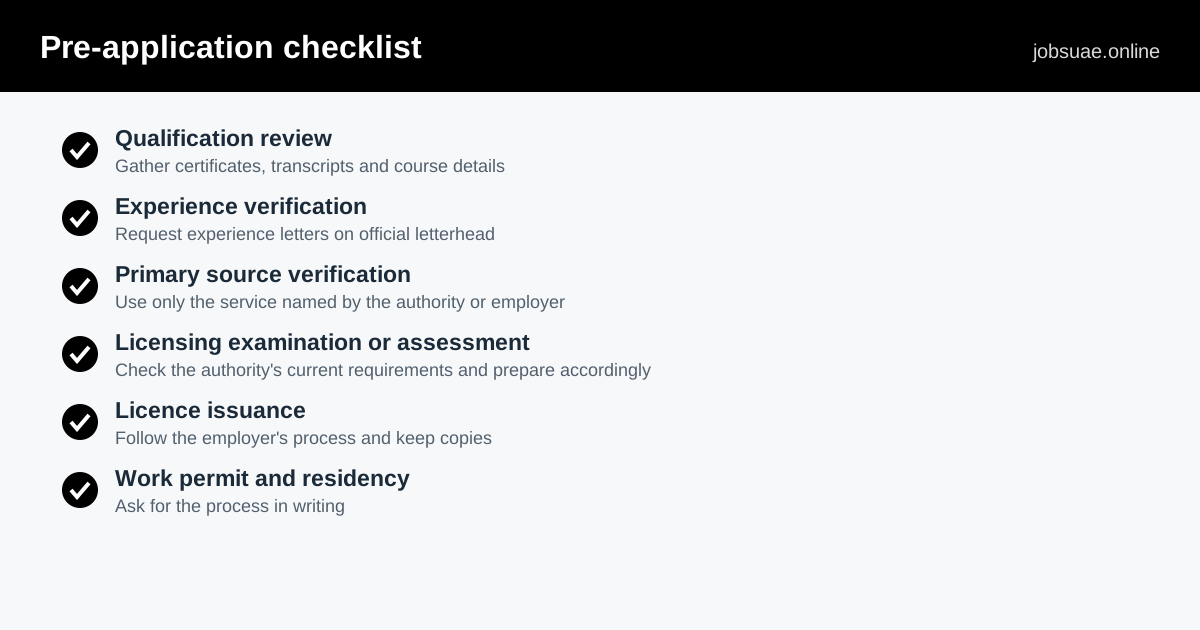
Details differ, but most licensing pathways involve the same broad stages. The table below summarises them. It is a general overview, not an official checklist.
| Stage | What usually happens | What you should do |
|---|---|---|
| Qualification review | The authority checks that your nursing degree or diploma is recognised | Gather certificates, transcripts and course details |
| Experience verification | Previous employment may need to be confirmed | Request experience letters on official letterhead |
| Primary source verification | Credentials are verified directly with the issuing institution, often through an approved verification service | Use only the service named by the authority or employer |
| Licensing examination or assessment | Some pathways require an exam or evaluation | Check the authority's current requirements and prepare accordingly |
| Licence issuance | The authority issues a licence linked to a facility or employer | Follow the employer's process and keep copies |
| Work permit and residency | The employer arranges permits through official channels | Ask for the process in writing |
Qualification checks in practice
Verification is the part that most often delays applications. Authorities want to confirm that your qualification is genuine, that the institution is recognised and that your training meets minimum standards. You may be asked for certified copies, transcripts, registration proof from your home country, a good standing certificate and evidence of recent clinical work.
To avoid delays, begin collecting documents early. Ask your university and previous employers how long they take to respond. Keep digital and printed copies in a single folder, and check that names and dates match across all documents, since inconsistencies can stall a file. If a name has changed, bring official proof.
Be careful with anyone who offers to "arrange" or "fix" documents. A forged certificate can end a career and lead to legal consequences. Use only official channels and the verification providers named by the authority or your employer.
Qualifications and experience employers ask for
Employers typically look for a recognised nursing degree or diploma, a valid registration or licence from your home country, and relevant clinical experience. Many hospitals prefer staff with experience in a specific area, such as emergency, intensive care, paediatrics, maternity, surgery or community care. Entry-level or graduate programmes exist at some organisations, but they are competitive and differ by employer.
Language skills are important. English is widely used in healthcare settings, and Arabic can be helpful for patient communication, although it is not always required. Basic life support and advanced certifications, where relevant, are often requested, and some employers ask for evidence that they are current.
Preparing a nursing CV
A nursing CV should be precise and easy to scan. Put your professional registration and licence status near the top, using accurate words such as "licensed in [country]" or "licence application in progress". Then list your experience in reverse order, naming the unit, type of patients, bed numbers if known and the skills you used. Compare "Worked in ICU" with "Provided care for ventilated adult patients in a 12-bed intensive care unit, including monitoring, medication administration and family communication." The second statement shows scope and responsibility.
Include education, training certificates and the dates they expire. Avoid exaggerating your responsibilities, because verification and reference checks are common. A step-by-step layout is in our UAE-style CV guide.
Where to apply
The safest sources are the career pages of hospitals, clinics and health groups, government health authorities that publish roles, and licensed recruitment agencies. Check the employer's identity, the contact email domain and the way the process is described. A genuine healthcare employer will explain the licensing process and will not ask you to pay for your own recruitment.
Be extremely cautious about advertisements that promise a guaranteed licence, a guaranteed visa or immediate hiring without an interview. Our guide to avoiding recruitment scams explains the warning signs and what to do if you have already paid money.
The interview
Nursing interviews usually combine clinical, behavioural and situational questions. You may be asked how you would handle a deteriorating patient, a medication error, a difficult family conversation or a conflict with a colleague. Strong answers follow clinical standards and teamwork: assess, escalate, document and communicate. Employers also ask about your experience with particular equipment, patient groups and shift patterns.
Prepare to discuss your career goals and why you want to work in the UAE. Ask about the unit, staffing ratios, orientation, shift patterns, professional development and the licensing timeline. Request information about accommodation, transport and who covers licensing and verification costs, and get the answers in writing.
Contracts and conditions
Before accepting, check the job title, unit, salary, allowances, working hours, rest days, probation, notice period and the timeline for licensing and permits. Ask whether the offer is conditional on obtaining the licence, and what happens if the process is delayed or unsuccessful. Reputable employers explain these conditions openly. Do not travel until you have a written offer and have confirmed the entry and permit process through official sources. For the official position on contracts and permits, go to MOHRE and u.ae rather than relying on a recruiter.
Professional development and career paths
Nursing careers can grow through clinical specialisation, charge nurse and supervisory roles, education and training, infection control, quality and patient safety, or management. Many employers support continuing education, but expectations vary. Keep your life support certifications current, record your training and seek mentors. A strong record of patient care and teamwork is the most reliable basis for advancement.
Planning your timeline and finances
Licensing and verification take time, and the timeline is rarely predictable. Plan for the possibility of delays by keeping enough savings to cover living costs while you wait, and avoid resigning from your current post until your offer, licence stage and entry process are confirmed in writing. Ask the employer which costs it covers, such as verification, licensing fees, medical tests and flights, and which fall to you. Keep receipts for every payment, and never pay a personal account for official fees. If someone claims that fees must be sent to an individual, treat it as a red flag and confirm through the authority's own website.
Mistakes nursing applicants often make
Candidates sometimes begin applying without any plan for verification, then discover that a document is missing and the process stalls. Others pay agents for "licence services", only to learn that the agent has no role in the official process. Some accept offers without clarifying which authority will license them or who pays for fees. A few use inaccurate job titles on their CV, which causes problems when verification letters do not match. The remedy is to plan the paperwork early, use official channels and keep your claims accurate.
Caring for yourself as a new arrival
Moving countries to nurse is demanding. Shift work, new systems, different patient populations and distance from family can be tiring. Find out about orientation, mentoring and support for new staff, and build routines for sleep, meals and contact with home. Colleagues from many countries work together in UAE hospitals, and asking questions early is a sign of professionalism, not weakness.
Licensing comes before the job offer
Nurses cannot practise on a CV alone. Licensing is handled by the health authority for the emirate: the Dubai Health Authority in Dubai, the Department of Health in Abu Dhabi, and the Ministry of Health and Prevention for several other emirates. Each sets its own evaluation process, which usually reviews your qualifications, experience and registration from your home country. Check the current requirements on the authority's own website, and apply only through its official portal. Many hospitals support the process for hired nurses, so ask the employer which steps it handles and who pays.
Documents to prepare early
- Degree or diploma and transcripts
- Current registration or licence from your home country
- Experience letters showing dates, ward type and duties
- Passport copy, photographs and, where requested, a certificate of good standing
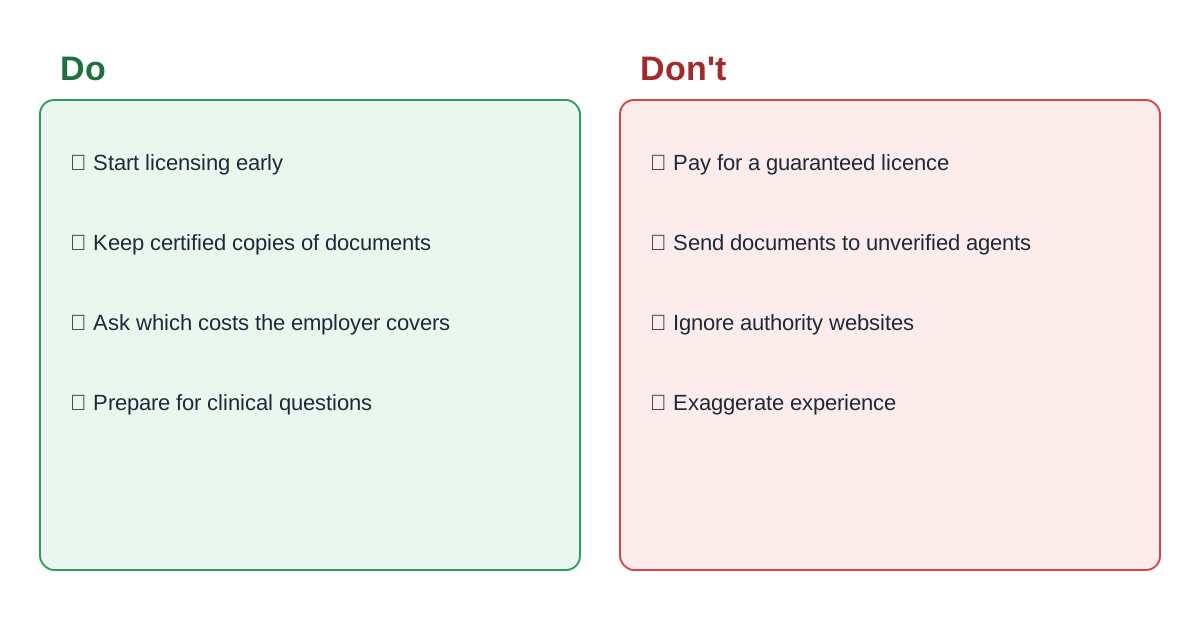
Attestation and verification can take weeks, so start collecting these before you apply. Be careful with anyone promising a "guaranteed licence" for a fee; the evaluation is done by the authority.
Conclusion
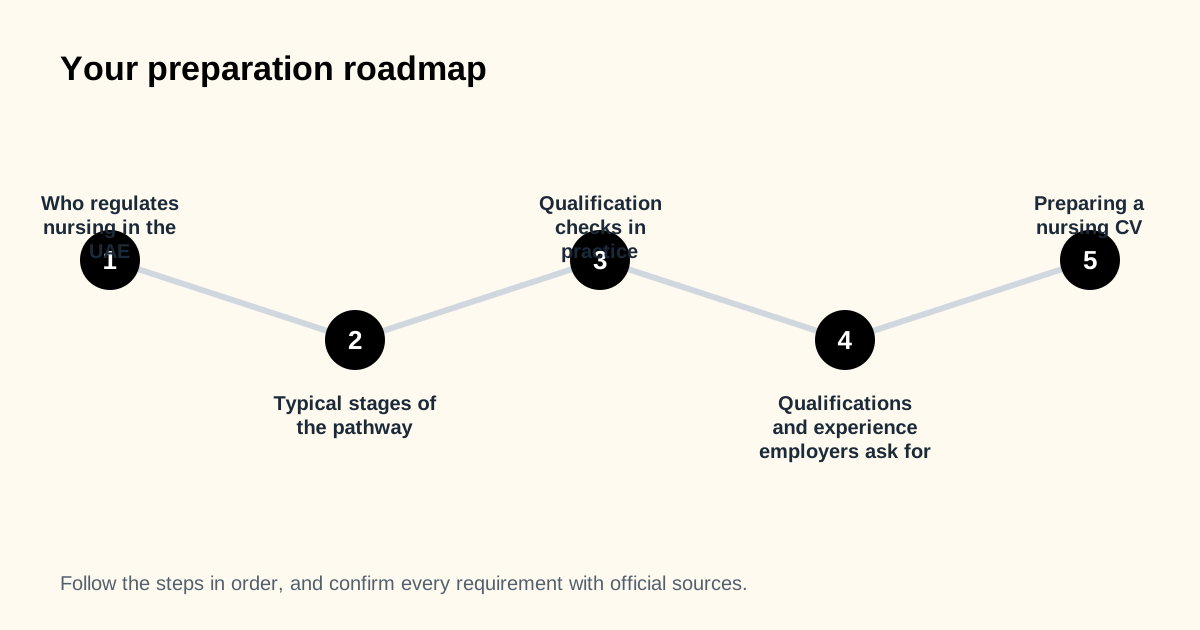
Nursing jobs in the UAE offer meaningful work and professional growth, but they depend on a careful, official licensing process. Learn which authority regulates your target emirate, prepare your documents early, present your experience accurately and ask employers to explain each step in writing. Your health authority and the UAE Government portal are the right places to confirm licensing steps, and MOHRE covers employment contracts. Patience and accuracy will protect your career and help you present yourself as a credible candidate.
Preparing for clinical interview questions
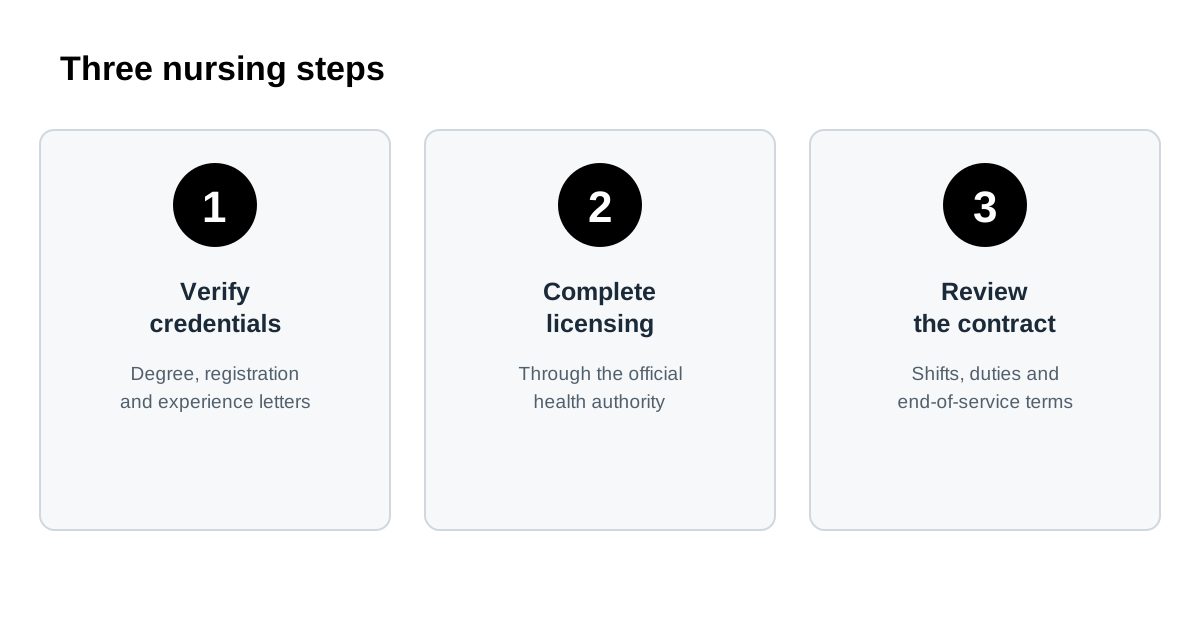
Nursing interviews often include scenario questions, such as how you would respond to a patient whose condition worsens, or how you would handle a medication discrepancy. Structure your answer: assess, act within your scope, escalate to the right colleague, document and follow up. Use examples from real shifts and avoid sharing identifiable patient details.
Evaluating the workplace
Ask about nurse-to-patient ratios, shift patterns, handover practice, continuing education and how incidents are reviewed. A supportive workplace usually explains these clearly. Also confirm accommodation, transport, flight and leave terms in writing before accepting.
Frequently asked questions
Which authority licenses nurses?
It depends on the emirate, for example the Dubai Health Authority, the Department of Health in Abu Dhabi and the Ministry of Health and Prevention elsewhere. Check each authority website for current rules.
How long does licensing take?
Timelines vary with documents, verification and the authority. Start early and keep copies of every submission.
Can an agent guarantee my licence?
No. The authority decides licensing. Be cautious of anyone selling a guarantee.