Driver Jobs in Dubai: Requirements, Licence Categories, and Application Tips
Driving is one of the most visible occupations in Dubai. Trucks move goods between ports, warehouses and shops, buses carry staff and students, vans serve businesses, and company drivers take managers to meetings. Because the work looks simple, people often underestimate how much employers check. A driver is responsible for an expensive vehicle, valuable cargo or other people's safety, so recruiters look closely at licence validity, experience, behaviour and reliability. This guide explains the main types of driving work, how licence categories relate to them, and how to prepare an application that is truthful and clear.
It does not list vacancies or promise placement. Traffic and licensing rules are set by the authorities and can change, so confirm current requirements before you spend money on anything.
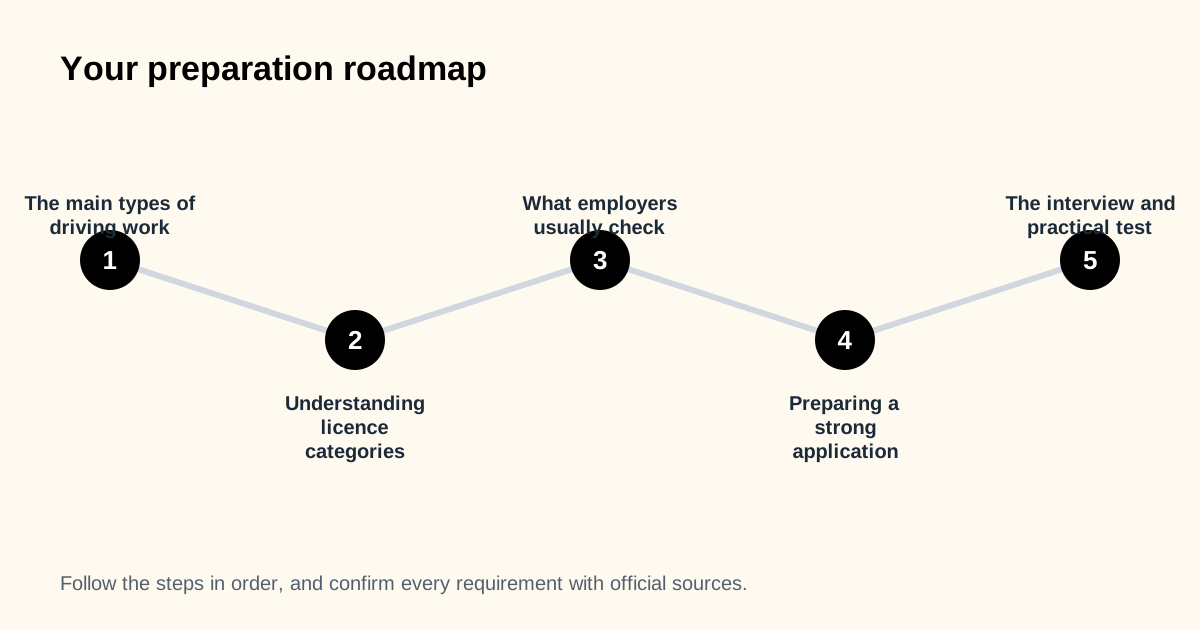
The main types of driving work
Driving jobs differ more than the title suggests, and your experience should match the one you apply for.
Company and chauffeur driving
Company drivers transport staff, guests or executives in cars or vans. Employers value punctuality, grooming, polite communication and a clean driving record. Knowledge of main roads, the ability to follow instructions about routes and timing, and discretion about what you hear are all part of the job.
Light goods and van driving
Van drivers deliver parcels, food supplies, equipment or retail stock. The work involves loading and unloading, paperwork, customer contact and tight schedules. Employers often ask whether you can use a smartphone app for routes and proof of delivery. Our separate guide to delivery roles covers app-based and courier work in more detail.
Heavy vehicle and truck driving
Heavy vehicle drivers handle trucks and trailers that carry construction materials, containers, fuel or general freight. These roles need the correct heavy licence category, stamina for long shifts, an understanding of load securing and an awareness of weight limits and safety rules. Experience matters, and employers may test you on the vehicle type before an offer.
Bus and passenger transport
Bus drivers work for schools, companies, tour operators and public transport providers. They carry passengers, so employers pay close attention to safety training, attitude and incident history. Some roles require additional permits or training beyond a standard licence.
Understanding licence categories
A driving licence is issued for specific vehicle classes, and the class on your licence must match the vehicle you will drive. In general terms, licences are separated into categories such as motorcycles, light vehicles, heavy vehicles and buses, and the specific names and rules are decided by the licensing authority in each emirate. In Dubai, driver licensing is handled by the Roads and Transport Authority (RTA), and other emirates have their own procedures.
If you hold a licence from another country, do not assume it is valid for employment in the UAE. Whether a foreign licence can be converted or exchanged depends on factors such as your country of issue and your residency status, and rules vary. Check the current position with the relevant authority before you apply for jobs that require a UAE licence. Do not pay agents who promise a "guaranteed licence", because the testing and approval process is run by the authorities.
What employers usually check
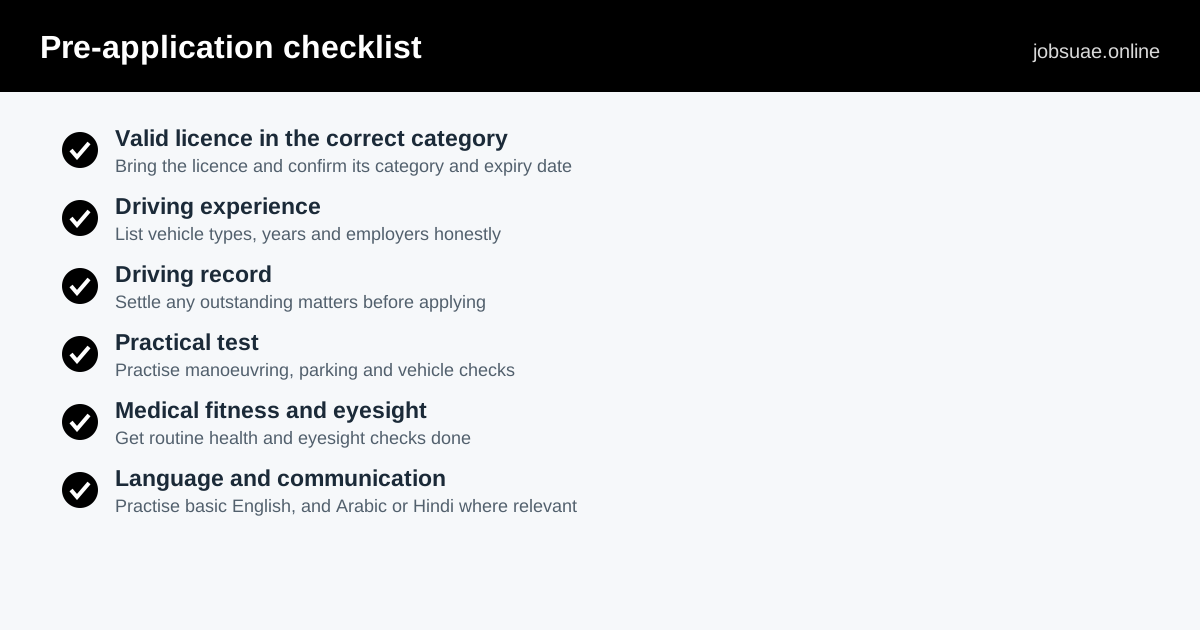
The table below shows common checks and how to prepare. It reflects general hiring practice, not a legal checklist, and each employer sets its own conditions.
| Check | What it tells the employer | How to prepare |
|---|---|---|
| Valid licence in the correct category | You are allowed to drive the vehicle | Bring the licence and confirm its category and expiry date |
| Driving experience | You can handle similar vehicles and routes | List vehicle types, years and employers honestly |
| Driving record | Your safety and compliance history | Settle any outstanding matters before applying |
| Practical test | Real skill, not just paperwork | Practise manoeuvring, parking and vehicle checks |
| Medical fitness and eyesight | You can work long hours safely | Get routine health and eyesight checks done |
| Language and communication | You can follow instructions and speak to clients | Practise basic English, and Arabic or Hindi where relevant |
| References | Reliability and conduct | Ask former supervisors for a short letter with permission |
Preparing a strong application
Start with a clear one-page CV, as described in our guide to writing a UAE-style CV. For a driver, the most important lines are the licence category, the vehicles you have driven, the type of routes or cargo, and any safety training. Instead of writing "good driver", write that you drove a certain vehicle type for a number of years on delivery routes with a particular employer, if that is true.
Mention practical strengths: you can use navigation apps, complete delivery paperwork, perform pre-trip vehicle checks, report faults and keep a log. If you have a clean record for a number of years, say so only if you can verify it. Add your current location and when you could start, because employers often need drivers quickly.
The interview and practical test
Expect questions about your experience, how you handle traffic, delays or difficult customers, and what you would do after a minor accident. A good answer is calm and procedural: stop safely, make sure everyone is unhurt, follow company and police reporting procedures, and inform your supervisor. Employers want to hear that you put safety ahead of speed.
If there is a driving test, arrive on time, inspect the vehicle before starting, adjust the seat and mirrors, use signals and keep to the speed limits. Nervousness is normal, but visible care helps. Ask what the working hours, shift rotation and rest breaks will be, because long hours and fatigue are a safety issue, not just a comfort issue.
Pay, benefits and contracts
Do not rely on figures from social media or from a recruiter who is vague. Pay for driving roles varies widely with the vehicle, the employer, the hours and the contract. Ask for the offer in writing and check the basic salary, allowances, overtime terms, accommodation, transport, fuel and fine policies, and who pays for traffic penalties. Be careful if an employer expects you to pay fines caused by company vehicle issues or deducts money without a written, lawful basis. Compare the terms against official guidance on contracts from MOHRE, and read our guide on avoiding recruitment scams before paying any fee.
Staying safe on the job
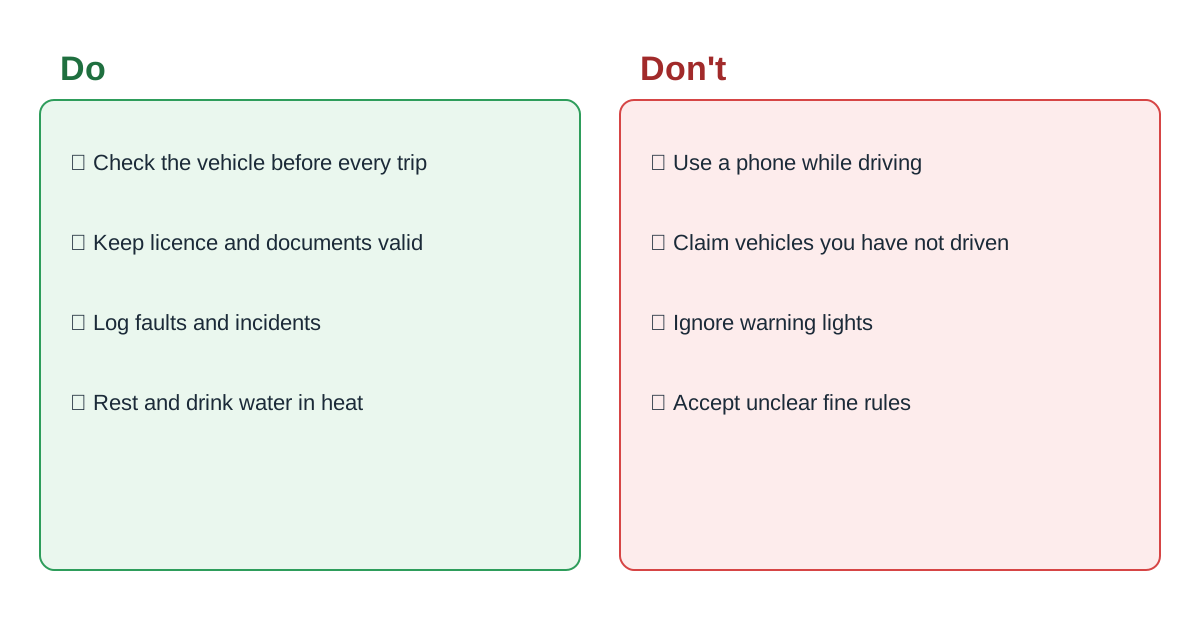
Safety is the foundation of a driving career. Carry out vehicle checks before each shift, including tyres, lights, brakes, fluids and load security. Avoid using a phone while driving, observe rest breaks and report faults rather than ignoring them. In summer heat, check coolant and tyres more often, and carry water. Record any incident immediately and keep copies of reports. A driver who builds a reputation for safe, calm and documented work becomes more valuable to an employer.
Mistakes driver applicants often make
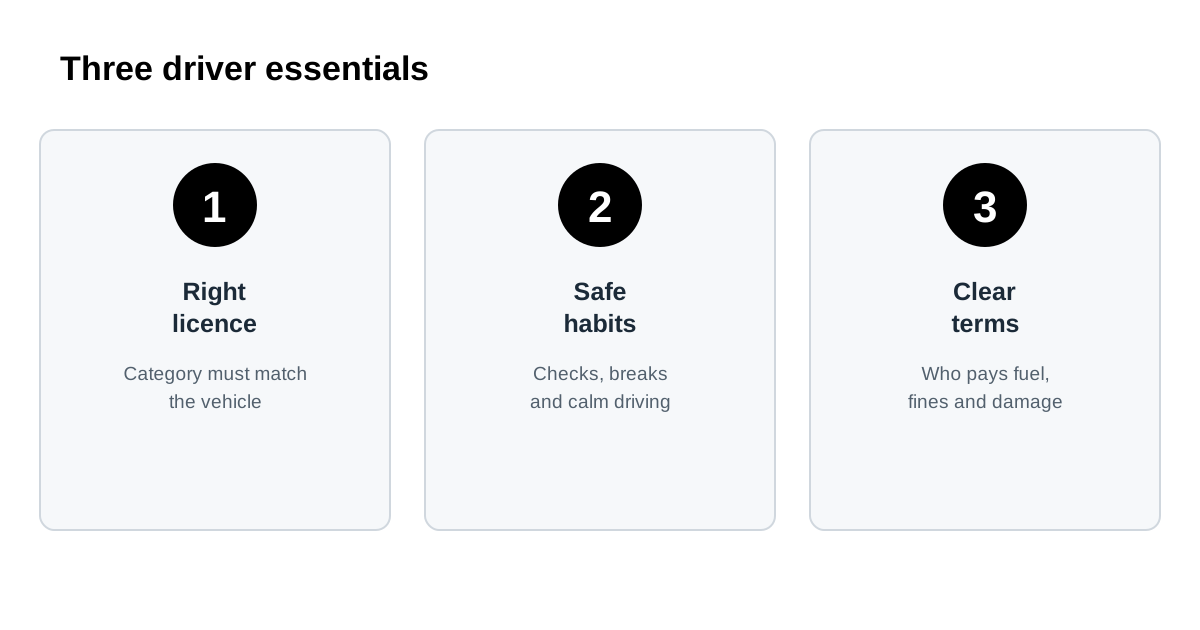
Some mistakes cost interviews even for capable drivers. Applicants sometimes list vehicle types they have only driven briefly, and the practical test then exposes the gap. Others let a licence approach expiry without renewing it, which makes an employer hesitate. Some send a CV with no licence category at all, forcing the recruiter to guess. Another frequent problem is ignoring the schedule: a candidate says yes to night shifts, then cannot attend, and the employer remembers. Finally, many applicants accept an offer without checking who pays fines, fuel and vehicle damage, and then discover costly deductions.
The fix is simple. Be exact about what you can drive, renew documents early, state your availability truthfully and ask for written terms.
A practical weekly routine for a driver job search
A steady routine beats occasional bursts of effort. Early in the week, check the career pages of logistics firms, bus operators, hotels and delivery companies, and note new roles. Midweek, send tailored applications and phone the employer once if a contact number is on its official site. Later in the week, practise for tests by reviewing vehicle inspection steps and road rules, and update your tracking sheet. Keep your licence, passport copy and reference letters ready in one folder so that you can respond within hours when a recruiter calls.
Career paths
Many drivers begin with light vehicles and build toward heavier categories, supervisory roles, dispatch coordination or fleet administration. Others move into logistics operations, where route planning and inventory knowledge matter. Additional training, such as defensive driving, first aid or dangerous goods awareness where available, can strengthen your profile, but check that any course provider is recognised before paying.
A pre-trip inspection routine employers notice
In practical tests, how you check a vehicle often says more than how you drive it. Learn a fixed order and repeat it every time: walk around the vehicle for damage and leaks, check tyres for wear and pressure, test lights, indicators and horn, confirm brakes and mirrors, look at fuel, oil and coolant levels, and make sure documents and safety equipment are on board. Report any fault in writing before leaving. Saying this routine aloud during a test shows discipline.
Handling a long summer shift safely
High temperatures stress both vehicles and drivers. Park in shade when possible, carry drinking water, take your rest breaks, and do not push through fatigue or dizziness. Check tyre pressure and coolant more often in summer. If your employer sets schedules that make rest impossible, raise it in writing with your supervisor, and keep a record.
Conclusion
Driver jobs in Dubai reward people who are reliable, careful and honest about their qualifications. Understand which licence category matches the work, prepare your documents and driving history, practise for the interview and test, and read every offer carefully before accepting. Confirm current licence rules with the licensing authority in your emirate and read the UAE Government portal before paying anyone for a permit or licence. With steady preparation, you can present yourself as the kind of driver employers trust.
Case example: choosing between two offers
Two offers arrive for a van driver. Offer A has a higher monthly figure but the driver pays fuel, fines and a share of repairs. Offer B has a lower figure, but fuel is provided and fines caused by the vehicle's condition are the company's responsibility. After estimating weekly fuel and possible deductions, Offer B leaves more money and less risk. The lesson is to compare what you keep, not what is advertised, and to get every cost rule in writing.
Building a safer record
Employers value drivers with few incidents and clear documentation. Keep a notebook or phone note with trip dates, faults reported and any minor incidents. A tidy record helps in interviews and in disputes.
Frequently asked questions
Can I use my home-country licence?
It depends on the country of issue and your residency status. Check the current conversion or exchange rules with the licensing authority before applying.
Do drivers need a practical test?
Many employers run a short road or vehicle test. Practise inspections, parking and safe manoeuvres, and arrive early.
Who pays traffic fines?
This varies by contract. Ask for the rule in writing and avoid deductions that have no written basis.