UAE Work Permits and Employment Visas: Official Information and Common Questions
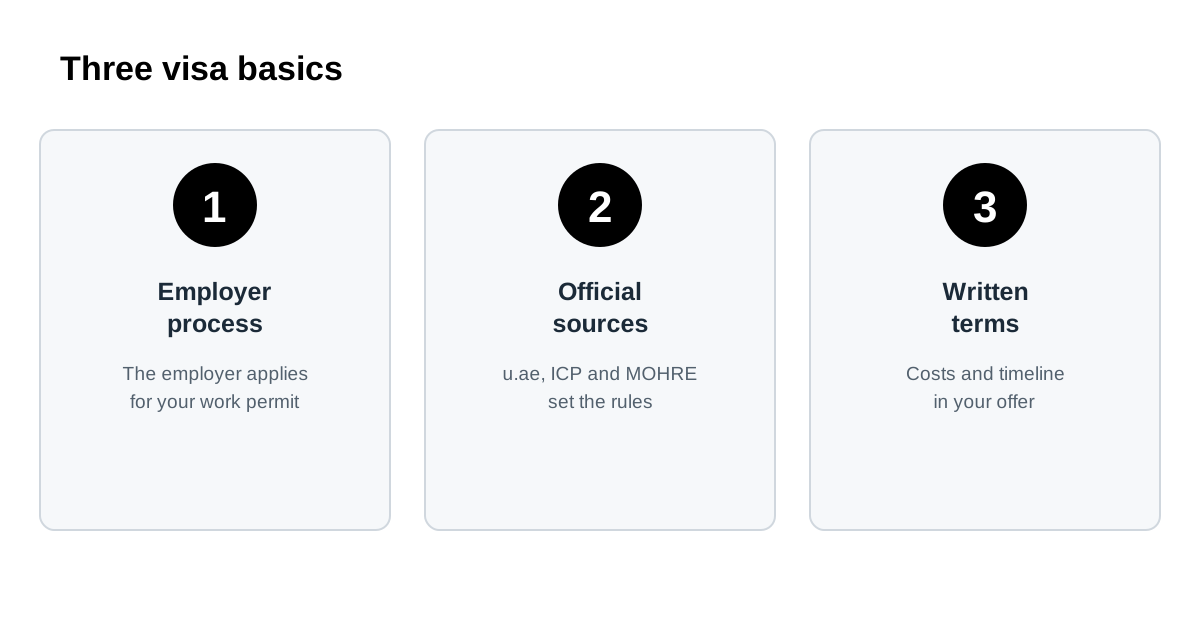
Few topics cause as much confusion for people who want to work in the UAE as work permits and visas. Rumours spread quickly in social media groups, agents quote prices without explanation and job seekers are told that "everything will be arranged". Because immigration and labour rules are set by government authorities and change over time, this guide does not try to give exact fees, processing times or document lists. Instead, it explains the general structure of the process, who is normally responsible for each part, which official sources you should use and how to ask the right questions. It is general information, not legal or immigration advice.
It does not promise visa approval or any outcome, and it does not list vacancies.
The basic idea: work authorisation and residency are different things
Two separate ideas are often mixed together. A work permit authorises you to work for a particular employer or in a particular arrangement. A residence visa allows you to live in the UAE. For most private-sector employees, both are arranged through official systems, usually by the employer, and they are linked: your residency is commonly tied to your employment. The exact documents and steps depend on factors such as your nationality, your job, the emirate, whether your employer is in a free zone or on the mainland, and whether you are already inside the country.
Because of this variety, a friend's experience may not match yours. Always check the process that applies to your employer and your situation.
The authorities you should know
Several official bodies are involved, and knowing their roles helps you find reliable information.
Ministry of Human Resources and Emiratisation (MOHRE)
MOHRE regulates private-sector employment on the mainland, including work permits, labour contracts and workers' rights. Its official website and channels explain how permits and contracts work and how to submit complaints.
Federal Authority for Identity, Citizenship, Customs and Port Security (ICP)
The ICP handles residency, identity and entry matters at federal level, and in Dubai the General Directorate of Residency and Foreigners Affairs (GDRFA) manages residency services. Each emirate has its own bodies and procedures, so look at the authority for the emirate that applies.
Free zone authorities
Companies in free zones are regulated by the free zone's own authority, which may have separate procedures for permits and residency. Ask your employer whether it is a mainland or free zone company and which authority applies.
The UAE Government portal
The u.ae portal gathers official guidance on visas, residency and employment in one place. It is a good starting point for general information and links to the relevant authority.
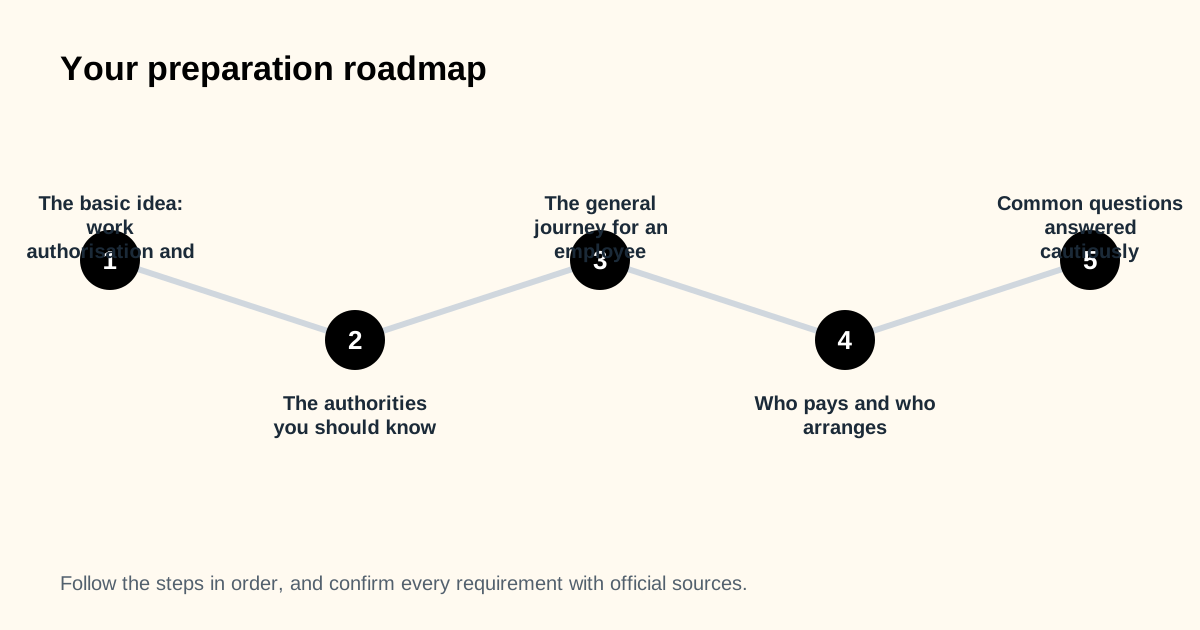
The general journey for an employee
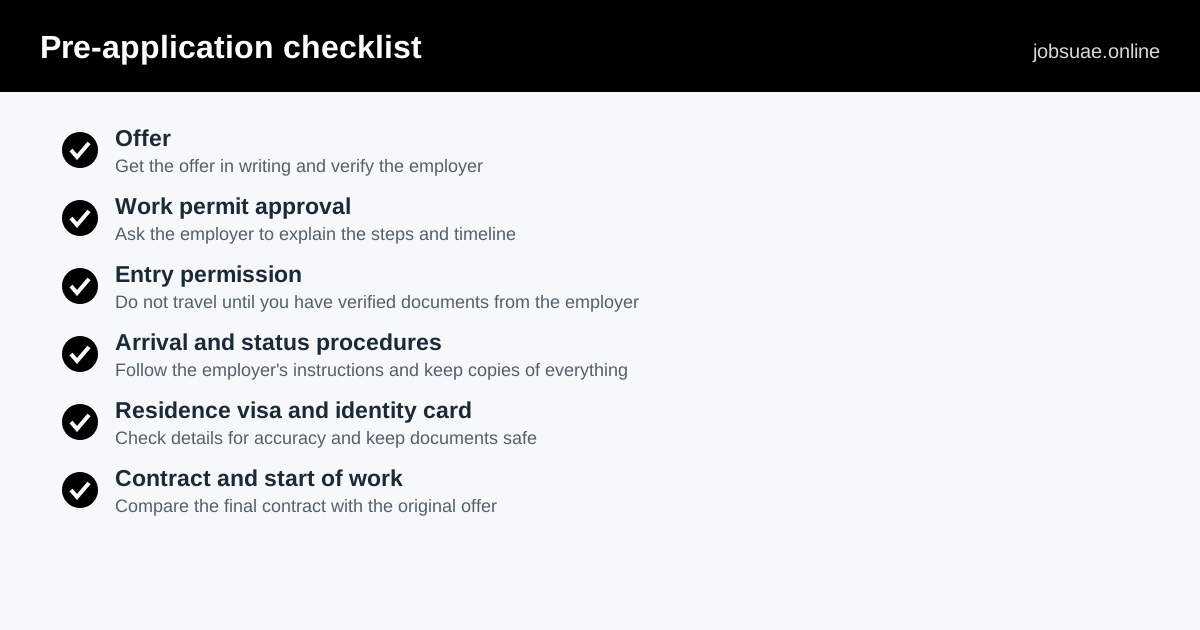
The table below describes a typical sequence for a worker hired from abroad by a mainland employer. It is a simplified overview, not an official checklist, and the order and requirements can differ.
| Stage | What usually happens | What you should do |
|---|---|---|
| Offer | The employer offers a job, often subject to conditions | Get the offer in writing and verify the employer |
| Work permit approval | The employer applies for permission to hire you through official systems | Ask the employer to explain the steps and timeline |
| Entry permission | An entry permit allows you to travel for employment | Do not travel until you have verified documents from the employer |
| Arrival and status procedures | Medical checks, identity registration and residency steps are completed | Follow the employer's instructions and keep copies of everything |
| Residence visa and identity card | Residency is issued and an identity card follows | Check details for accuracy and keep documents safe |
| Contract and start of work | The labour contract is registered and the job begins | Compare the final contract with the original offer |
Who pays and who arranges
As a general principle, the employer is responsible for arranging and covering the costs of recruiting a private-sector worker, including work permit and visa processing. A legitimate employer or licensed agency does not ask you to pay a fee to be hired. Rules and exceptions exist, and they can change, so confirm the current position with MOHRE and the UAE Government portal rather than relying on an agent's explanation.
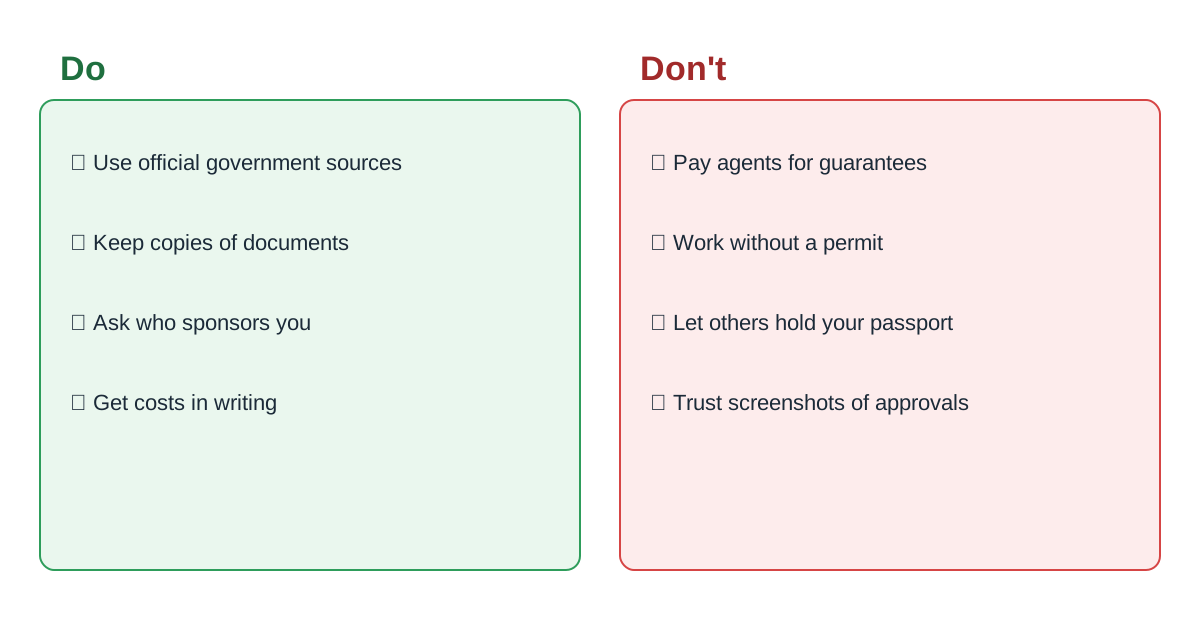
If someone claims that you must pay a "visa fee", "security clearance" or "processing charge" to a person or personal account, treat it as a serious warning. Our guide to avoiding recruitment scams explains the warning signs and what to do if you have already paid.
Common questions answered cautiously
Can I work on a visit visa?
A visit visa is generally for visiting, not for employment. Working without proper authorisation can have legal consequences. If you are told to enter on a visit visa and that "the job will be arranged later", ask for a written, verifiable explanation and confirm it with official sources before you travel.
Can I look for a job while I am in the UAE?
Many people come to the UAE to search for work, and there are official options that allow job seekers to stay for a limited time. Availability, eligibility and conditions change, so check current visa categories on the UAE Government portal and the ICP or GDRFA website before you plan a trip.
Does the employer keep my passport?
Employers should not hold employees' passports as a condition of work. If this is requested, seek guidance from official channels, and keep copies of your documents. Hand over originals only for legitimate, short official procedures and ask for confirmation.
How long does the process take?
Timelines depend on the employer, the authority, the completeness of documents and other factors, so there is no single answer. Ask the employer for an honest estimate, and do not resign from your current job or sell belongings until the process is confirmed in writing.
What if my documents need attestation or verification?
Many qualifications must be verified or attested, particularly for regulated professions. Requirements depend on your country and profession. Ask the employer and the relevant authority what is needed, and use only official channels or verification services named by them. Do not pay anyone who offers to "arrange" documents without proper verification.
Can I change employers?
Rules for changing jobs exist and depend on your contract and circumstances. Check current guidance from MOHRE before you resign or sign a new contract, so that you understand notice periods, permit changes and any conditions.
Other residency routes
Besides employer-sponsored residency, the UAE has introduced several other categories, such as long-term residency for some investors, specialised professionals and other groups, and permits for freelancers or remote workers in certain cases. Eligibility rules, fees and conditions are set by the authorities and change from time to time. If you think you may qualify, read the official description on the UAE Government portal and the relevant authority's website, and be careful with agents who promise approval.
Documents to keep safe
Whatever your route, keep digital and printed copies of your passport, photographs, qualifications, offer letter, contract, permit and residency documents. Store digital copies in a secure place, and share them only with verified parties. Note the names of people you deal with, along with dates and references. If problems arise, these records help you explain your situation.
Checking information before you act
When you read a claim about visas or permits, ask where it comes from. Prefer government websites, official channels and written statements from verified employers. Treat screenshots, voice messages and social media posts with caution, especially when they mention urgent deadlines, special quotas or fixed prices. If a source cannot be traced to an official authority, do not act on it. Our guide to checking employment offers explains how to verify what employers tell you.
Questions to ask your employer
Prepare a short list of questions and send them in writing. Ask which legal entity is applying for your work permit, which authority regulates that entity, which steps you must complete and in what order, which documents you must provide and when, who pays each cost and what will happen if an application is delayed or refused. Ask when the final contract will be provided and whether the job offer is conditional on any approval. Keep the replies. Clear written answers are a good sign of a well-run employer, and evasive answers are information too.
Mistakes permit and visa applicants often make
Some job seekers rely on agents who promise guaranteed visas and then lose money. Others travel on the wrong visa category and face difficulties. Some resign before the permit process is confirmed. A few hand over passports without understanding why. To avoid these problems, verify the employer, ask for written explanations, use official sources and keep records.
Questions to put to any employer
Ask which entity will sponsor you, who pays visa and medical costs, and what the written timeline is. Visa rules change, so confirm the current process on the official UAE Government portal, ICP or MOHRE. Never pay an individual for a visa promise, and keep copies of every document.
The usual employment journey, step by step
Processes differ by emirate, employer and nationality, so treat this as a general map and confirm every stage with the official UAE Government portal, ICP or MOHRE.
- Offer and contract. The employer issues a written job offer with salary, duties and conditions. Read it fully before agreeing.
- Work permit. The employer, not you, normally applies for the work permit through the official system, using the information you provide. You should not be asked to pay a stranger to "arrange" it.
- Entry and status. Depending on where you are, you may enter on an employment entry permit or change status inside the country. Never accept an arrangement that uses a visit visa as a substitute for a real work permit without checking the rules.
- Medical fitness and biometrics. Residence applications usually involve a medical fitness test and fingerprints at an approved centre.
- Emirates ID and residence. After approval, your residence is stamped or issued digitally and you receive an Emirates ID. Keep copies of every document.
Who pays for what
Costs commonly discussed include work permit fees, medical tests, Emirates ID and flights. Rules on who bears recruitment and visa costs are set by labour regulations, and employers are generally expected to carry recruitment costs rather than pass them to workers. Always ask for the cost split in writing, then check it against current MOHRE guidance before signing.
Other routes people ask about
The UAE has introduced several longer-term and special residence categories in recent years, such as long-term residence for qualifying investors, specialists and others, and options for remote workers or job seekers. Eligibility, fees and conditions change, so use only the official portal to see what applies to you, and ignore social media posts that promise a "guaranteed" visa.
Red flags in visa conversations
- Someone asks you to pay personally for a visa that the employer should arrange.
- You are told to enter on a tourist visa and "convert it later" with no written confirmation.
- An agent holds your passport as a guarantee.
- The company cannot give you a licence number or a signed offer.
If you are unsure, pause the process and contact MOHRE or the official helpline instead of continuing with the agent.
Conclusion
UAE work permits and employment visas follow official procedures that are usually managed by the employer, and they depend on your situation. Understand the difference between work authorisation and residency, know which authorities are involved, ask who arranges and pays for each step and never rely on rumours. Rely on the UAE Government portal, MOHRE and your emirate's residency authority for current permit and visa rules, not on forwarded messages. Careful questions and good records are the best protection you have.
Documents you may be asked for
Employers commonly request a passport valid for several months, passport-size photographs, educational certificates, experience letters and a signed offer or contract. Some roles need certificates to be attested, which can take time, so ask early which documents are required and in what format. Keep both digital and paper copies, and note the dates of issue and expiry.
After you arrive
Once the residence process is complete, keep your Emirates ID and residence details safe, and update your address and contact details through the official channels when they change. Store a copy of your labour contract separately, and know the official channels for questions, such as the MOHRE helpline.
Changing status or leaving the job
If you resign, are terminated or change employer, the rules about notice, final settlement and status can differ. Read your contract and check current guidance on official sites before taking steps. Do not rely on social media advice, which may be outdated.
Frequently asked questions
Who applies for the work permit?
In most employment cases the employer applies through the official system. Confirm the process for your situation with official sources.
How long does it take?
Timelines vary by employer, emirate and case. Ask the employer for an expected timeline in writing and check official updates.
Can I change employer later?
Rules depend on your contract, status and current regulations. Check the official guidance before resigning or signing a new offer.