UAE Employment Offers: How to Check Contract Terms and Benefits
A job offer is exciting, and that excitement can make it hard to read the details. Yet the offer and the contract that follows decide your pay, hours, leave, notice period and many other parts of your daily life. In the UAE, where many workers arrive from abroad and may be unfamiliar with local practice, careful reading is especially important. This guide explains the difference between an offer and a contract, which terms to check, which benefits to ask about, how to use official sources, and which warning signs should make you pause. It is general information, not legal advice, and rules can change, so confirm current requirements with the relevant authority.
It does not list vacancies, give salary figures or promise any outcome.
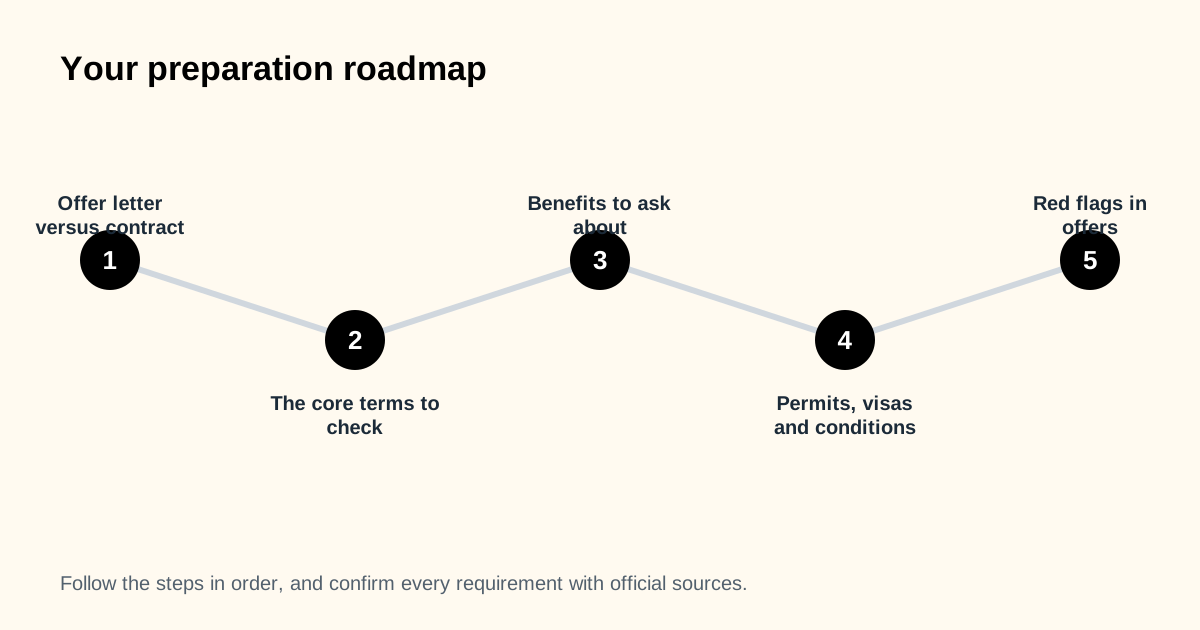
Offer letter versus contract
An offer letter states that an employer wishes to hire you on certain terms. It may be conditional on checks such as qualification verification, medical tests, licensing or the issue of a work permit. A contract is the formal agreement that sets out the rights and duties of both sides once the process is complete. The two should match. If the contract differs from the offer, ask why and request the change in writing before you sign.
For private-sector employees, MOHRE publishes information about employment contracts, offer letters and work permits, and the UAE Government portal explains the process in plain language. Read these pages first, so that you know what a normal process looks like. Free zones and government entities may follow different procedures, so check the rules that apply to your employer.
The core terms to check
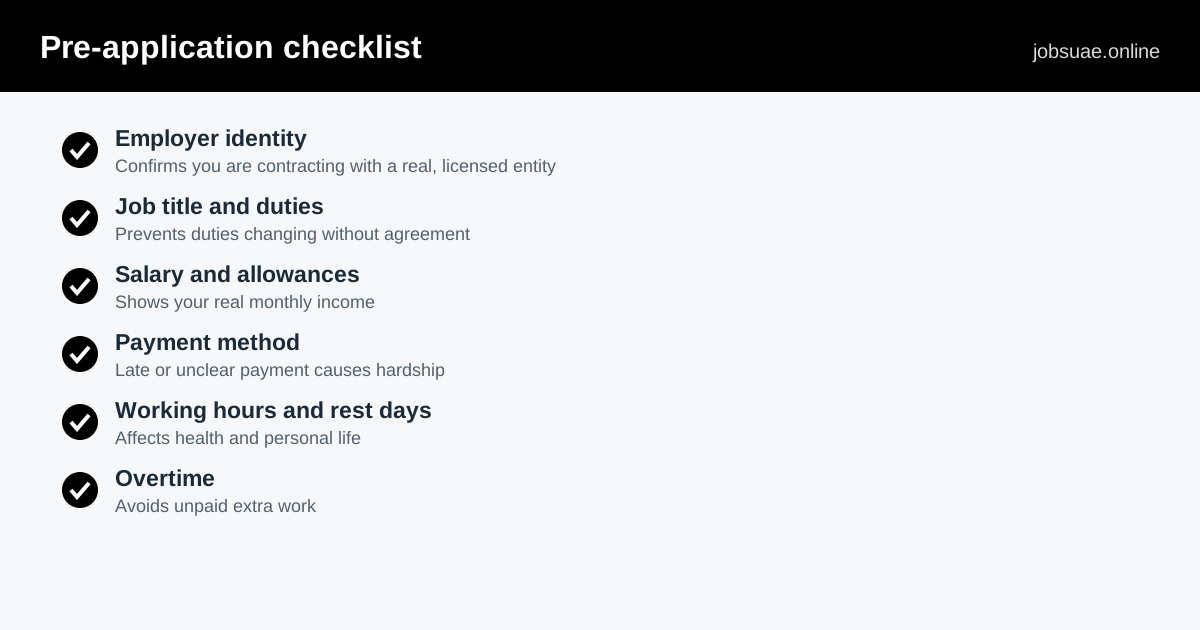
Read every line slowly, and mark anything unclear. The table below lists the main terms and what to confirm. It is a checklist, not a statement of what any employer offers.
| Term | What to check | Why it matters |
|---|---|---|
| Employer identity | Legal company name, licence details and address | Confirms you are contracting with a real, licensed entity |
| Job title and duties | A clear description matching what you discussed | Prevents duties changing without agreement |
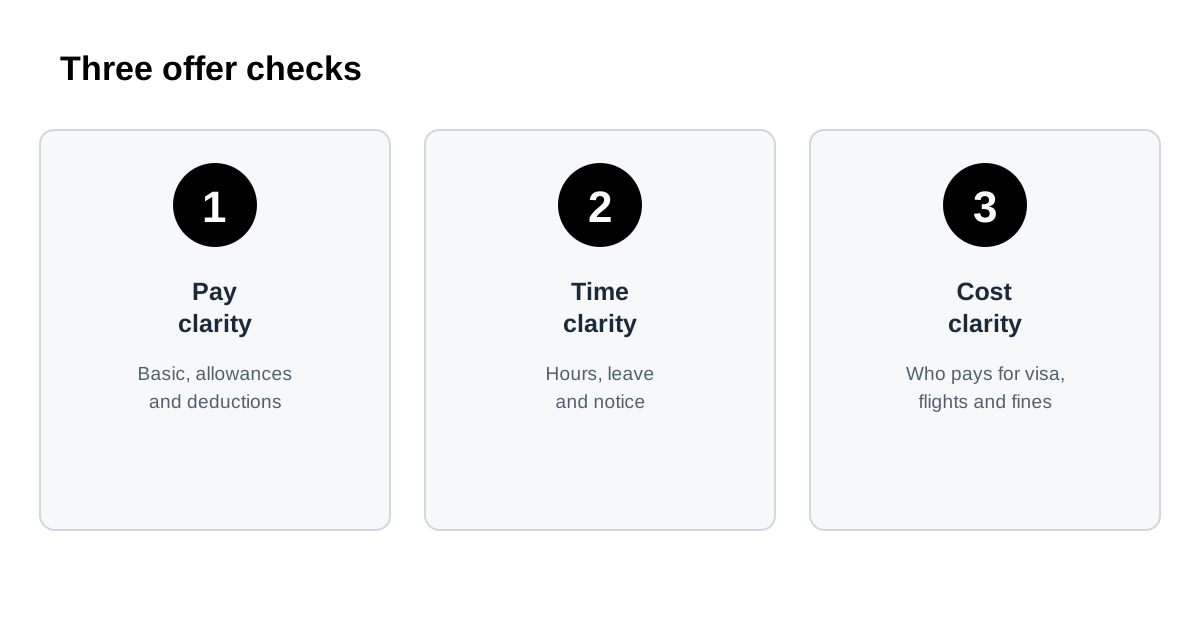
| Salary and allowances | Basic pay, allowances and how each is paid | Shows your real monthly income |
| Payment method | Date, currency and how wages are paid | Late or unclear payment causes hardship |
| Working hours and rest days | Daily hours, weekly days off, shift patterns | Affects health and personal life |
| Overtime | How extra hours are recorded and paid | Avoids unpaid extra work |
| Probation | Length and conditions during the probation period | Affects your security at the start |
| Notice period and termination | How either side can end the contract | Defines your rights if things change |
| Contract duration | Start date and whether it is fixed term | Shows how long the arrangement lasts |
| Work location | Where you will work and any travel | Affects commuting and living costs |
Benefits to ask about
Salary is only one part of the package. Ask clearly about the following items, and get the answers in writing.
Accommodation and transport
Some employers provide housing or an allowance, and some provide transport. Ask whether these are included, who pays and what happens if you leave. If accommodation is provided, ask about the location, room sharing and rules.
Medical cover
Employers are generally responsible for arranging health insurance for their employees under rules that apply in each emirate, but the extent of cover differs. Ask what is covered, whether dependants are included and how claims work.
Annual leave, public holidays and sick leave
Check how many days of leave you receive, when it can be taken and how public holidays are treated. Ask about sick leave procedure and any documents needed.
End-of-service benefits
Many employees are entitled to an end-of-service payment calculated under the applicable rules. The details depend on factors such as contract type and length of service, so check the current position with MOHRE rather than relying on a recruiter's explanation.
Flights, visas and relocation
Ask who pays for your visa and permit costs, your flight and any relocation expenses. A legitimate employer does not require you to pay recruitment fees to secure a job. If you are asked to pay, treat it as a serious warning and seek official guidance.
Training and bonuses
Ask whether training is provided, whether any bonus is guaranteed or discretionary and what conditions apply. If a bonus depends on targets, make sure the targets are written down.
Permits, visas and conditions
Most private-sector employees need a work permit arranged through official channels, and the employer normally manages this process. The sequence of steps, such as offer, permit, entry and medical checks, can vary. Ask the employer to explain it, and verify it through MOHRE and the UAE Government portal. Do not travel until the offer is confirmed in writing and the process has been explained, and be cautious of any suggestion that you enter on a visit visa and "sort it out" later without a verifiable arrangement. Our guide to work permits and employment visas covers the general official process in more detail.
Red flags in offers
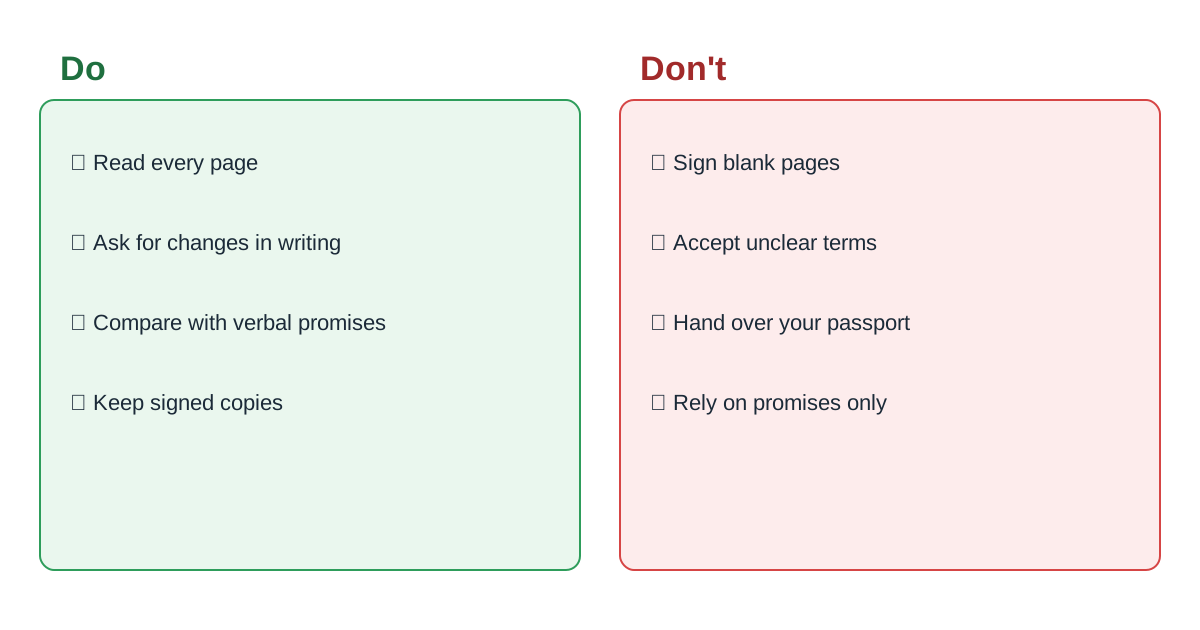
Some offers should make you stop. Be cautious if the employer or recruiter asks for money for the job, visa or "registration", refuses to give a written contract, offers a salary far above normal for the role, uses a free email address as the company contact, pressures you to sign immediately or asks you to hand over your passport. Be wary if terms change after you accept or if the contract is in a language you cannot read. Our guide to avoiding recruitment scams explains these warning signs in depth, and our guide to job interviews explains how to ask questions during the process.
How to read a contract step by step
First, read the entire document once without stopping, to understand the overall picture. Second, read it again and highlight terms that differ from what you were told. Third, list your questions and send them in writing. Fourth, ask for a copy of any policy documents mentioned, such as a staff handbook. Fifth, keep a copy of the signed contract and every related email. If the contract is in a language you do not understand, ask for a translation or help from a trusted person, and do not sign something you cannot read.
Consider asking a knowledgeable friend, a former colleague or a licensed professional to read it with you. If something seems unfair or unclear, it is reasonable to negotiate respectfully. A genuine employer will usually answer questions calmly.
An example of reading a clause
Reading clauses with a question in mind makes them easier to understand. Imagine a contract says that "working hours are as required by the company". That sentence is vague, so ask what the normal daily hours are, how many days per week and how extra time is recorded. If the contract says "the employee may be assigned other duties", ask what kind of duties and whether the job title or pay would change. If a clause mentions deductions, ask which deductions, for what reasons and under what rules. Each unclear sentence should become a written question.
Keep the answers. A reply by email is better than a verbal assurance, because it shows what was agreed. If the employer refuses to clarify, take that as information about how the relationship may work later.
Questions to send before you sign
A short list of questions makes the process practical. Ask for the exact job title and reporting line, the monthly pay broken into basic salary and allowances, the date and method of payment, the working schedule, the probation terms, the notice period, the annual leave and public holiday arrangements, the medical cover details and the process for the work permit. Ask who pays for each step and when you will receive the final contract. Send these questions in one polite message so that the answers can be kept together.
Comparing offers fairly
When you have more than one offer, compare the whole package, not just the headline salary. Add up the value of accommodation, transport, medical cover, leave, bonus and end-of-service rights, and subtract any costs you will bear, such as commuting or fines. Consider the working hours, location and growth prospects. A slightly lower salary with housing and transport included may be worth more in practice than a higher salary with none, but the right choice depends on your situation.
What to do if there is a dispute later
Keep records. Save your contract, payslips, messages and any proof of attendance. If a problem arises, raise it first with HR or your manager in writing. If it is not resolved, MOHRE provides complaint and dispute channels for private-sector workers, and the UAE Government portal explains how to access them. Seek advice early, and avoid abandoning your job without understanding the consequences, because it can affect your legal position.
Mistakes people reviewing offers often make
Some applicants sign without reading, trusting a verbal promise. Others focus on salary and ignore hours or notice terms. Some pay recruiters before seeing a contract. A few resign from their existing job before the offer is confirmed. To avoid these problems, insist on writing, read carefully, verify the employer and wait for confirmation before making irreversible decisions.
A line-by-line offer review
Before signing, copy each item below into a note and mark whether your offer states it clearly in writing.
- Job title and duties: does the title match what you were interviewed for?
- Salary breakdown: basic salary versus allowances, because some benefits are calculated on basic pay only.
- Working hours, overtime and rest days: how overtime is counted and paid.
- Probation and notice period: how long each lasts, and what happens if either side ends the job.
- Leave and flights: annual leave, public holidays, and whether a return ticket is provided.
- Accommodation, transport and medical cover: what is included and what is deducted.
- Visa and recruitment costs: who pays, stated in writing.
- End-of-service benefits: how gratuity is calculated; our gratuity calculator gives a general estimate.
Warning signs inside a contract
Be cautious if the contract is only in a language you cannot read, if the salary differs from the verbal promise, if blank spaces are left to be filled later, or if you are told to sign first and "fix details" afterwards. Be careful with any clause saying your employer may hold your passport; check current MOHRE guidance, because holding workers' documents is generally not allowed.
What to do if something does not match
Write a short, polite email listing each difference and ask for a corrected version. Keep every copy. If the employer refuses, decide whether the job is worth the risk. If you are already employed in the UAE and have a dispute, MOHRE provides official complaint channels, so use those rather than informal agents.
Conclusion
Checking an employment offer is not distrust. It is ordinary professional care. Read each clause against the official explanations on MOHRE and the UAE Government portal, and sign only what you understand. Never pay for a job, and never travel on a promise alone. A few hours of careful checking can protect you from months of difficulty.
Understanding the pay structure
A total package can hide how much is guaranteed. Basic salary is the fixed core, while allowances for housing or transport may be listed separately, and some benefits may be calculated only on basic pay. Ask for a table showing each component, how often it is paid and whether any deductions apply. Compare two offers on guaranteed pay, not headline figures.
Probation, notice and termination
Contracts normally describe a probation period and a notice period for each side. Check how long each lasts, what happens to unpaid leave and what end-of-service benefits you could expect. Misunderstandings here cause many disputes, so ask for clarity in writing and keep a signed copy.
Negotiating politely
Prepare two or three priorities, such as a start date, a review date or transport support. Explain your reasons briefly, thank the employer and ask them to confirm any agreed change in the contract itself.
Frequently asked questions
Can I negotiate an offer?
Yes. Be polite, specific and realistic, and ask for changes in writing. Employers often have fixed ranges but may adjust items such as start date or leave.
What if the offer differs from the contract?
Ask for a corrected version before signing and keep both documents. Do not rely on verbal explanations.
Should I sign immediately?
No. Take time to read the whole document and ask questions, even if the employer says it is urgent.