UAE Job Interview Preparation: Common Questions and Strong Answers
An interview is not an exam that you either pass or fail. It is a structured conversation in which an employer tries to decide whether you can do the job, fit the team and be relied on, and in which you decide whether the job is right for you. In the UAE, where candidates come from many countries and employers compare large numbers of applicants, preparation is often what separates similar profiles. This guide explains the common interview formats, the questions you are most likely to meet, a simple way to structure answers, and the practical details of etiquette and follow-up. It uses general examples, so adapt them to your own truthful experience.
It does not list vacancies and cannot guarantee any outcome. Interview practices differ between companies and sectors.
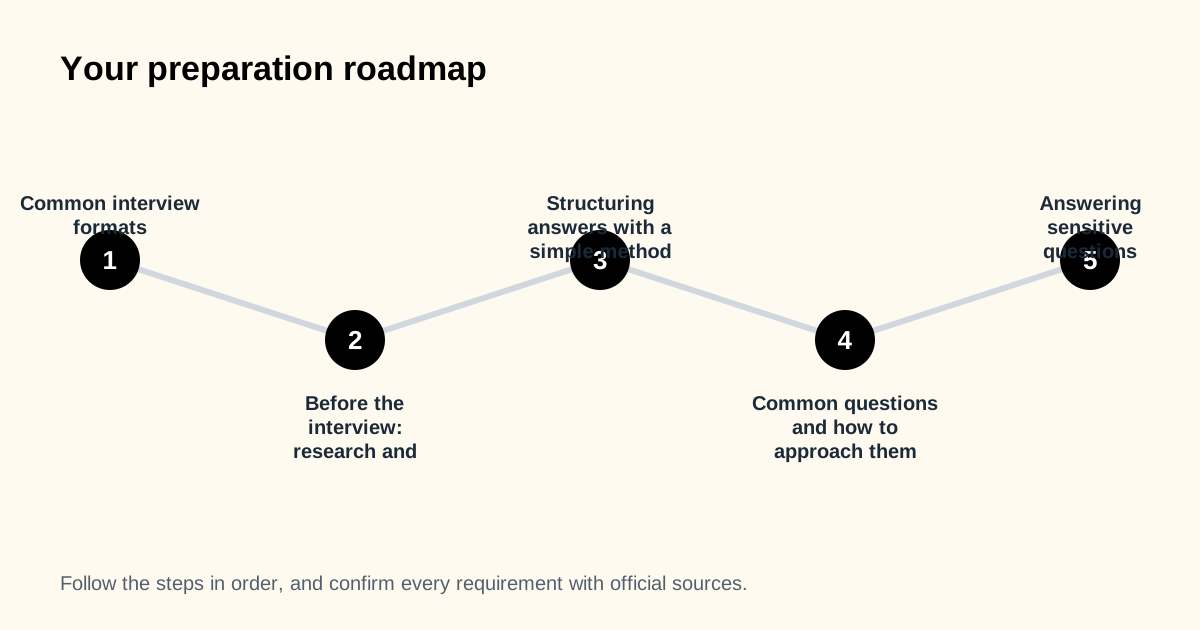
Common interview formats
Phone screening
A recruiter calls to check basic facts: your current location, availability, notice period, experience, languages and salary expectations. Be ready to answer clearly and briefly, from a quiet place with a charged phone. Write a few notes in advance and have your CV open.
One-to-one interview
The most common format is a conversation with a hiring manager or HR representative. Expect questions about your background, skills, behaviour in specific situations and motivation.
Panel interview
Several interviewers ask questions in turn. Make eye contact with the person who asked the question, but include the others as you answer. Note names at the start if you can.
Practical test or trial
Some roles include a practical task: a typing test, a short presentation, a driving test, a kitchen trial or a role-play. Ask what to expect and prepare accordingly. Our role-specific guides, such as those for receptionists and accountants, describe typical tests.
Video interview
Interviews on video are common, especially for candidates abroad. Test your connection, camera and microphone beforehand, choose a quiet room with simple background and look at the camera when you speak. Have a backup plan, such as a phone number to call if the link fails.
Before the interview: research and preparation
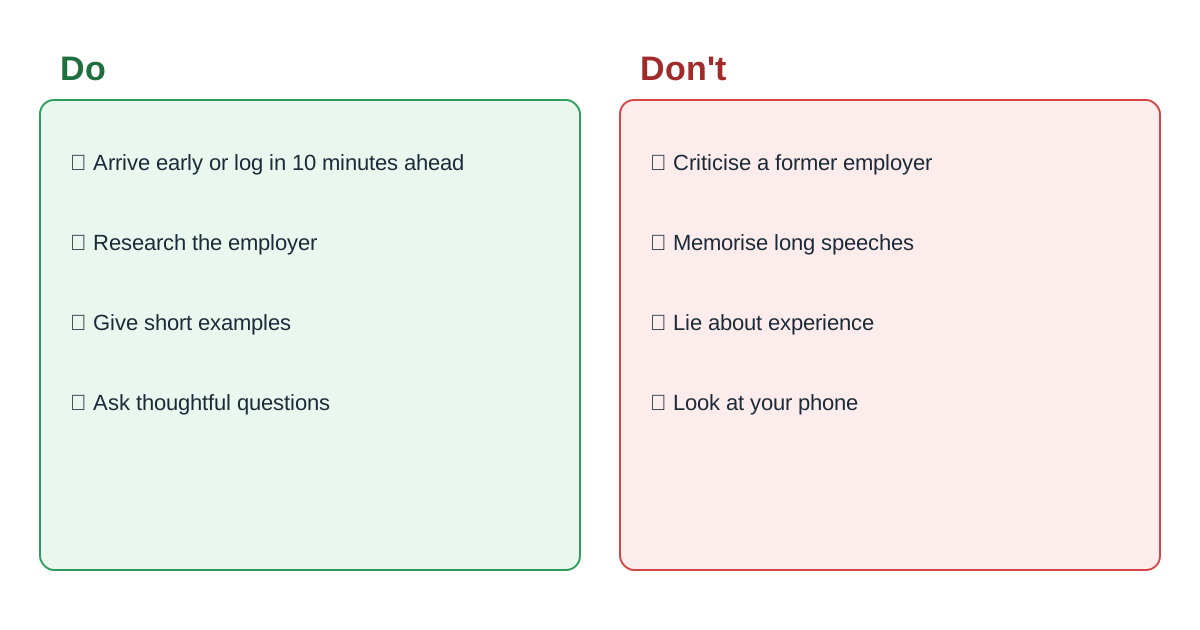
Start with the employer. Read the company's website, its services, its recent news and the job advert again. Know what the company does, who its customers are and what the role is likely to involve. Prepare a short explanation of why you want this job at this company, which should mention something specific, not just "a good opportunity".
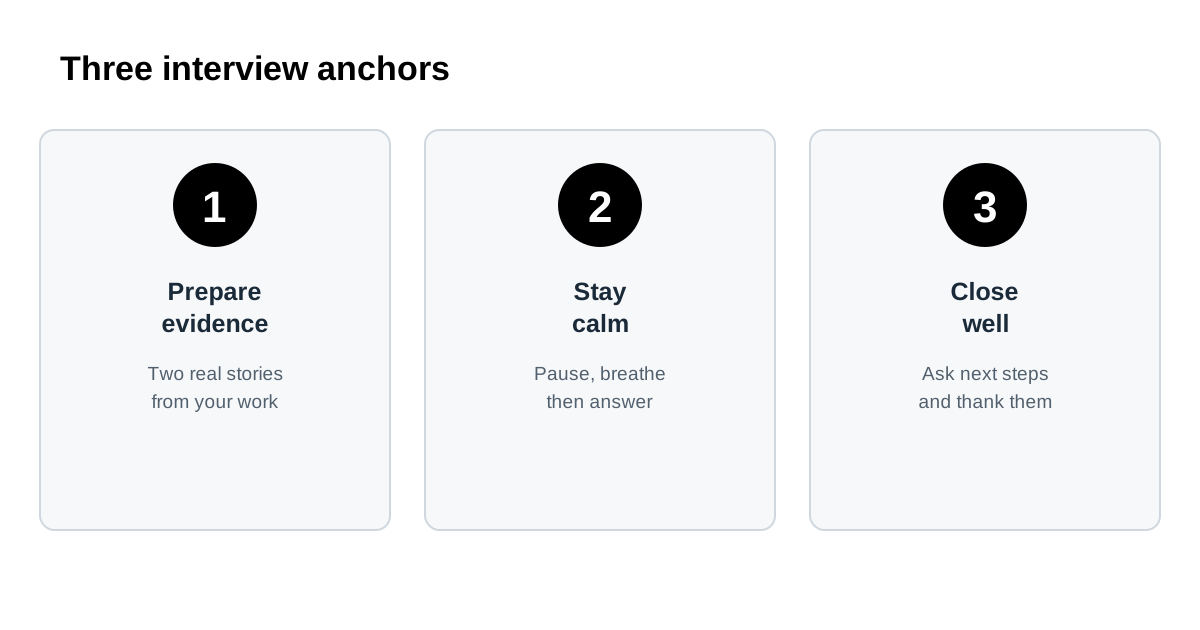
Next, prepare your evidence. List four or five real examples from work or study that show your skills: a problem you solved, a mistake you corrected, a time you helped a team or a difficult customer you handled. Practise saying them aloud in a clear, short form. Finally, check logistics: the address, route, travel time, contact person and what to bring, such as your CV, certificates and identification. Arrive early, because traffic and parking can be unpredictable.
Structuring answers with a simple method
For questions about past behaviour, a simple structure keeps you focused: describe the situation briefly, explain your task, say what you did and share the result. This is often called the STAR method, and it prevents rambling answers. For example, to the question "Tell me about a time you handled a difficult customer," you might say: "A customer was upset because their order was late (situation). I needed to calm the situation and find a solution (task). I listened, apologised, checked the status and offered a replacement with a delivery time (action). The customer accepted and thanked me, and I recorded the issue so the team could prevent it (result)."
Keep answers to about one to two minutes. If you do not have a direct example, explain how you would handle the situation using the same steps, and be clear that it is a plan, not a past event.
Common questions and how to approach them
The table below lists questions that appear often and a sensible way to prepare. These are examples, not scripts.
| Question | What the interviewer wants to know | How to prepare |
|---|---|---|
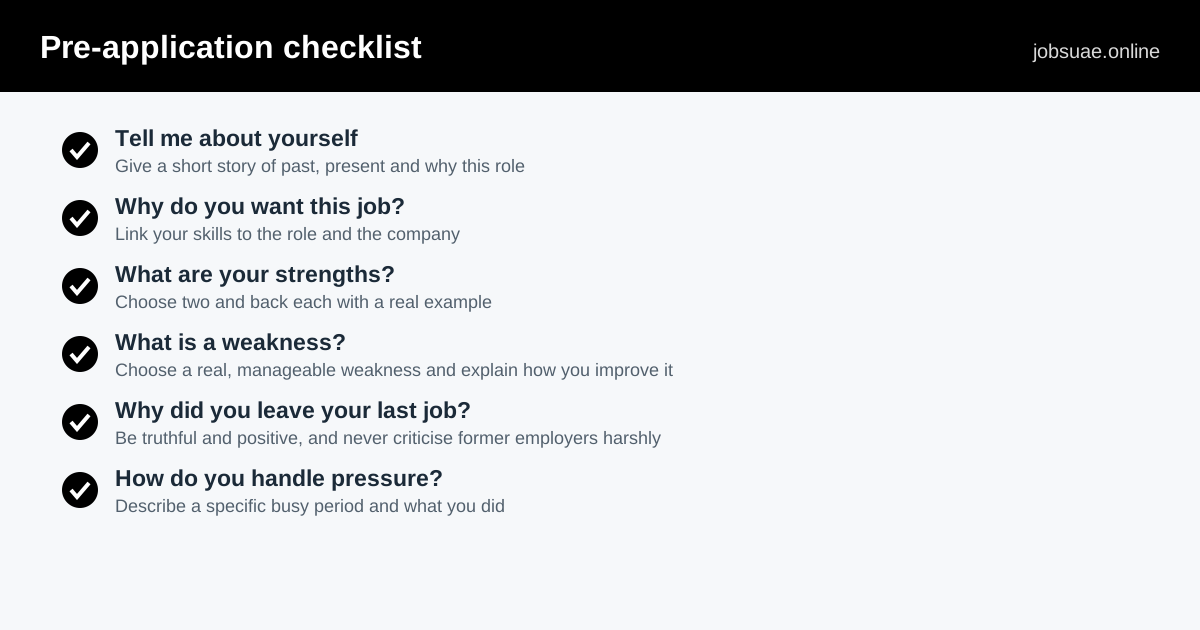
| Tell me about yourself | Whether you can summarise your background clearly | Give a short story of past, present and why this role |
| Why do you want this job? | Your motivation and research | Link your skills to the role and the company |
| What are your strengths? | Skills relevant to the job | Choose two and back each with a real example |
| What is a weakness? | Self-awareness and growth | Choose a real, manageable weakness and explain how you improve it |
| Why did you leave your last job? | Honesty and professionalism | Be truthful and positive, and never criticise former employers harshly |
| How do you handle pressure? | Calm and organisation | Describe a specific busy period and what you did |
| What are your salary expectations? | Fit with the budget | Research reasonable ranges and say that you are open to discussing the full package |
| When can you start? | Your availability and notice period | State your real notice period and any visa or travel timing |
Answering sensitive questions honestly
Some questions are awkward. If you have a gap in your work history, explain it briefly and truthfully, for example a career break, relocation or study, and move to what you did to stay current. If you were dismissed or left on poor terms, state the facts calmly, say what you learned and focus on the future. If you lack a required skill, say so, explain what you have done to learn it and show willingness to improve.
When asked about salary, avoid inventing a figure. Research typical ranges from several reputable sources, and consider the whole package, including accommodation, transport, medical cover and leave. It is acceptable to ask what range the employer has in mind. If an interviewer asks for personal information that seems unrelated to the job, you may politely steer the conversation back to your qualifications.
Etiquette and presentation
First impressions begin before you speak. Dress neatly and professionally, in line with the industry. Greet everyone politely, including reception staff, with a smile and a handshake if the interviewer offers one. Be mindful of cultural differences in greeting, and follow the interviewer's lead, particularly with people of a different gender. Turn off your phone, sit calmly, listen without interrupting and use a respectful tone. Avoid speaking negatively about previous employers or colleagues.
Body language matters as much as words. Sit upright, keep your hands visible and calm and make steady eye contact where it feels natural. If you do not understand a question, ask politely for it to be repeated. A short pause before answering is fine and shows thought.
Questions you can ask
Good questions show interest and help you judge the job. You might ask what a typical day looks like, how success is measured in the first months, what training is provided, how the team is organised, what the working hours and shift patterns are, and what the next steps in the process will be. Avoid asking only about salary and leave at the first meeting, but do make sure you understand the basic terms before accepting an offer. Our guide to checking employment offers explains what to verify.
Spotting interview red flags
Genuine interviews follow a recognisable pattern. Be cautious if the interview takes place only through a messaging app with no company email, if the interviewer cannot explain the job clearly, if you are offered the position within minutes without questions or if you are asked for payment, a deposit or your passport. Our guide to avoiding recruitment scams explains the warning signs. If something feels wrong, you can end the conversation and verify the company independently.
After the interview
Send a short thank-you message within a day, restating your interest and mentioning something specific from the conversation. If you were given a timeline, wait until it has passed before following up, then send one polite message. Keep notes on what was asked, how you answered and what you could improve, because each interview teaches you something useful.
If you receive an offer, ask for it in writing and take time to read it. If you are rejected, ask politely for feedback, and treat it as information, not a verdict. Keep applying to other roles while you wait.
Mistakes interview candidates often make
Some candidates arrive without researching the company and give generic answers. Others speak for too long or too briefly, or exaggerate their skills and are caught by follow-up questions. Some criticise previous employers, which makes interviewers wonder how they would speak about the new one. Others forget practical details, such as the address or required documents. To avoid these problems, prepare examples, practise aloud, be honest and plan your logistics.
Answering the questions that decide most interviews
"Tell me about yourself." Give a 60-second answer in three parts: your current role or experience, one achievement that fits this job, and why this employer interests you. Do not recite your whole life.
"Why do you want to work in the UAE?" Employers prefer specific reasons: the industry here, a skill you want to grow, or family and long-term plans. Avoid answers that focus only on salary.
"Why did you leave your last job?" Stay factual and calm. Say you completed a contract, relocated or wanted broader responsibility. Never criticise a former employer.
"What are your salary expectations?" Research typical pay for the role from several sources, and give a reasonable range or ask what the budgeted range is. Avoid quoting figures you cannot justify.
"Do you have any questions?" Always ask something. Good examples: what a successful first three months looks like, what the working hours and shift pattern are, and what the next step in the process is.
A simple structure for behavioural questions
When asked about a difficult customer or a mistake, use four short steps: the situation, your task, what you did, and the result. Choose an example from real work, and end with what you learned. Practise out loud with a friend, because answers that sound fine in your head often ramble when spoken.
After the interview
Send a two-line thank-you message within a day, restating your interest and availability. If you hear nothing within the time they gave you, follow up once politely. If you receive an offer, read it fully before replying, and compare it with our guide to offers and contracts.
Online and phone interviews
Test your connection and sound beforehand, sit in a quiet place with a plain background, and keep notes nearby. Dress as if meeting in person, look at the camera while speaking and keep your answers short, since delays make long answers harder to follow.
Conclusion
Interview success in the UAE comes from preparation, honesty and respectful communication. Learn about the employer, prepare real examples, structure your answers clearly, ask thoughtful questions and verify the opportunity before you commit. Verify the opportunity first, then use MOHRE and the UAE Government portal to check the offer that follows the interview. With steady practice, you can present yourself as the capable and trustworthy candidate you are.
The first five minutes
Interviewers often form an impression early. Greet them by name, smile, offer a brief handshake only if they do, and keep your documents in a clean folder. When you sit, place your phone on silent out of sight. Your first answer should be your 60-second introduction, so practise it until it sounds natural but not memorised.
Common role-based questions
Drivers may be asked about accident procedures, hospitality staff about handling complaints, accountants about reconciliations and month-end, and warehouse staff about safe lifting. Prepare one short real example for each question that fits your field, and be honest when you do not know something. Saying "I have not done that, but I would learn it by..." is better than guessing.
Practice routine
Practise out loud for 15 minutes a day for a week. Record yourself, check for filler words, and refine two or three strong stories. Ask a friend to ask unexpected questions so that you learn to stay calm.
Frequently asked questions
How early should I arrive?
Aim for 10 to 15 minutes early for in-person interviews, and test the link and sound ten minutes ahead for online ones.
What should I wear?
Dress neatly and one level above the role. Clean, simple clothes are better than expensive ones.
Is it fine to ask about salary?
Yes, politely and usually after the employer has described the role. Research typical pay first.