Latest UAE Job Search Guide: How to Identify Genuine Vacancies
Open any job board or social media group and you will find hundreds of adverts for jobs in the UAE. Some are genuine and current, some are outdated copies that circulate for months, some are collections of vague "urgent hiring" posts and a few are traps. Sorting them takes time, and many job seekers lose weeks applying to positions that do not exist. This guide offers a practical method for judging an advert in a few minutes: how to read it, what to verify, how to tell whether it is still open and how to keep your search organised. It focuses on evaluating adverts, while our separate guide to avoiding recruitment scams explains the criminal side in more depth.
This guide does not list vacancies, and it does not describe any role as currently hiring. A vacancy is only real if you can confirm it with the employer or a reliable, dated source.
Why "latest" does not mean "genuine"
Websites and groups often label posts as "latest" or "urgent" to attract clicks. A post may have been copied from an older advert, republished many times or written to collect applicants' details rather than to fill a job. Freshness and authenticity are different questions, and you need to check both. A genuine advert is one that comes from a real employer or authorised agency and has a real opening. A current advert is one that is still open and recently posted.
Step 1: read the advert closely
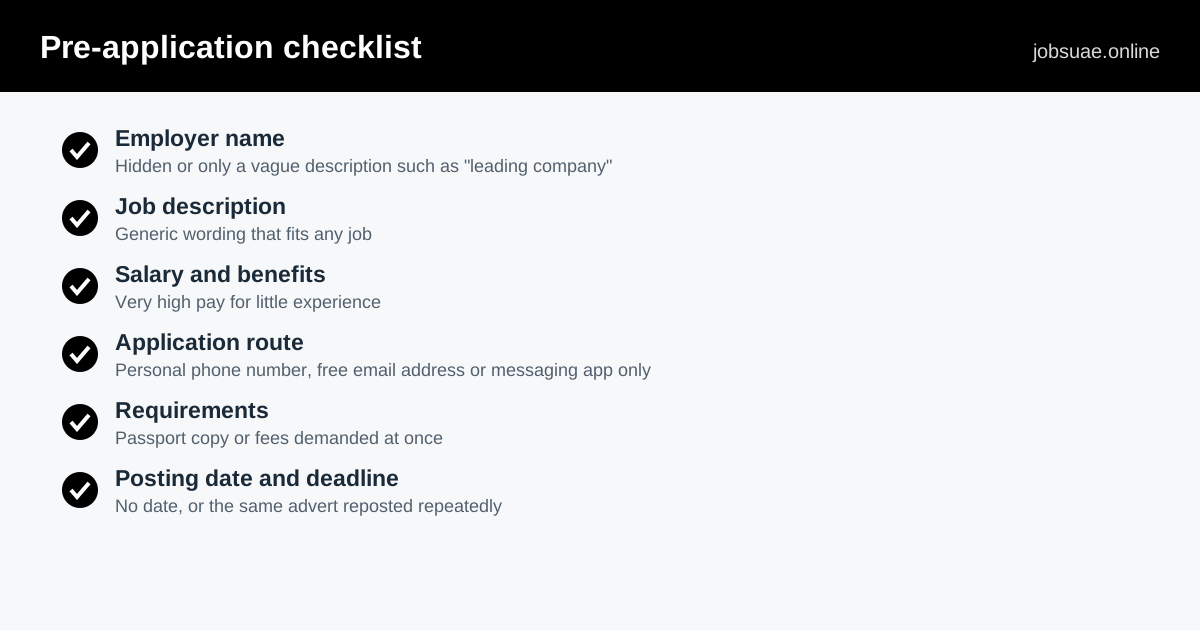
Genuine adverts usually contain specific information. Look for the employer's name, the job title, a description of duties, required skills and experience, the work location and a clear way to apply. Compare it with the sample patterns in the table below.
| Feature | Usually a good sign | Reason to be careful |
|---|---|---|
| Employer name | Named clearly, with a traceable website | Hidden or only a vague description such as "leading company" |
| Job description | Specific duties and requirements | Generic wording that fits any job |
| Salary and benefits | Realistic or not stated, with details given later in writing | Very high pay for little experience |
| Application route | Company career page or corporate email address | Personal phone number, free email address or messaging app only |
| Requirements | Relevant skills, experience and documents at the right stage | Passport copy or fees demanded at once |
| Posting date and deadline | Clear date, sometimes a closing date | No date, or the same advert reposted repeatedly |
| Language and presentation | Consistent, professional writing | Many spelling errors, shouting capitals and pressure to act now |
Step 2: trace the employer
Search the employer's name yourself, without clicking the link in the advert. Look for an official website, a physical presence, a record of what the company does and a careers page. Compare the contact details in the advert with those on the official site. If the advert uses an email address, check whether its domain matches the company's real domain. If the employer is a recruitment agency, ask which company the role is for and verify the agency's licence with the relevant authority.
Some strong employers do not advertise every role publicly, so absence from a career page does not prove fraud, but it is a reason to contact the company directly using details from its official site.
Step 3: confirm the vacancy is still open
An advert may be genuine but old. Check the posting date, and if there is none, treat it with caution. Look for the same role on the employer's own site or professional profiles. If you can, send a short, polite message to the recruiter or HR contact asking whether the position is still open and what the process is. A reply from a corporate address with clear information is encouraging. Silence for several weeks suggests that the role may have been filled.
Remember that large employers often hold continuous recruitment for common roles, such as customer service or retail, so a posting may be open for long periods. That is different from a re-posted advert with no responsible contact.
Step 4: check the requirements for sense
Compare what the advert asks with what the job normally involves. A driver advert that requires no licence, a nurse advert that skips professional licensing or an accountant role that needs no qualification should make you pause. Our role guides, such as those for driver jobs, nursing jobs and security guard jobs, describe what regulated or skilled roles typically ask for.
Also check how the advert treats permits and visas. Genuine employers explain that the permit process is handled through official channels. Be cautious if an advert implies that you can work without proper authorisation or must pay for a visa. Our guide to work permits and visas explains the general process.
Step 5: judge the application process
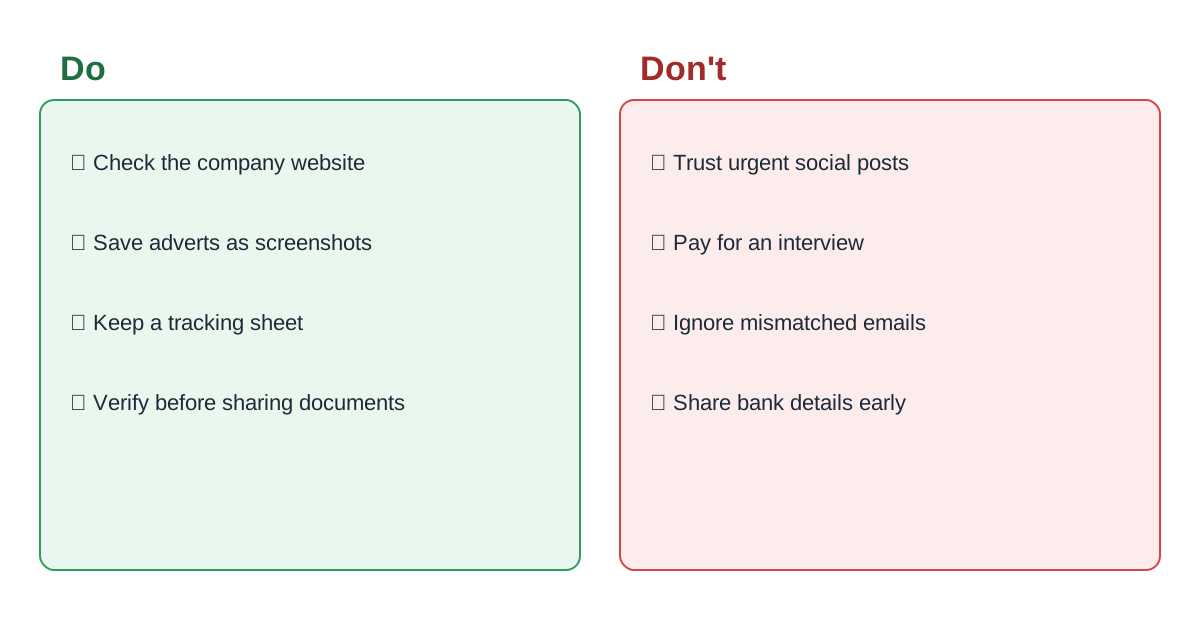
A genuine application process normally asks for a CV first, followed by an interview and an offer, and it asks for sensitive documents later. Watch the order of steps. If you are asked to send your passport, bank details or a payment before any interview, stop. If the interview is only a short messaging chat and you are told you are selected immediately, be cautious. If the process involves a payment to a person, treat it as a red flag.
A short worked example
Imagine two adverts for a warehouse helper role. The first names a logistics company, describes the duties, states the location, asks for a CV through the company's career page and has a posting date from this month. The second says "urgent staff needed, high salary, free visa and accommodation, send passport copy to this number". The first can be verified by visiting the company's website and checking the page. The second offers no way to verify and asks for a sensitive document at once. Without any further information, the first deserves your effort and the second does not.
Step 6: organise your search
Keep a simple record of every application: date, employer, role, source, contact person, documents sent and status. Mark each advert as "verified", "unverified" or "rejected", and note why. This habit prevents repeated applications to the same suspicious post and shows patterns, such as which sources produce replies. For a wider search plan, read how to find jobs in Dubai.
Set a limit on how long you spend on each advert, such as ten minutes for checking and applying. Concentrating on verified, relevant roles is more effective than sending dozens of applications blindly.
Sources worth using
Prefer employer career pages, official government careers portals for public-sector roles, established job boards that identify employers, professional networking platforms with verifiable company profiles and licensed recruitment agencies. For information about permits and contracts, use the UAE Government portal and MOHRE. Treat social media posts as leads to verify, not as proof.
What to do when you cannot verify an advert
If you cannot confirm an advert after reasonable checks, you can skip it. There are always other roles, and no genuine opportunity requires you to take unreasonable risks. If you decide to apply anyway, send only a CV, avoid sharing sensitive documents and never pay money. If you suspect fraud, report the post to the platform and, where appropriate, to the relevant authorities.
Using professional networks wisely
Professional networking platforms can help you verify employers, but they need careful use. Check that a recruiter's profile has a history, connections that make sense and a company page that matches the employer's official site. Be cautious with new profiles, stock photos or messages that arrive out of the blue with unusually generous promises. If a recruiter contacts you, ask for the job title, the hiring company and the next step in the process, and look for the same role on the company's career page. Genuine recruiters are used to these questions and answer them directly.
Setting realistic expectations
Even when you verify a vacancy, the process takes time. Large employers may take weeks to respond, and many applicants compete for each role. Set a weekly target for verified applications, follow up once after a reasonable period and keep building your skills while you wait. A steady, careful approach tends to work better than constant rushing.
Mistakes job seekers checking adverts often make
Some job seekers apply to every advert, which leaves them with little time to prepare. Others trust posts because they have many likes or shares. Some forget to record where they applied and apply twice. A few ignore warning signs because they are desperate for work. To avoid these problems, verify first, apply carefully, keep records and trust evidence over pressure.
A 6-point test for a genuine vacancy
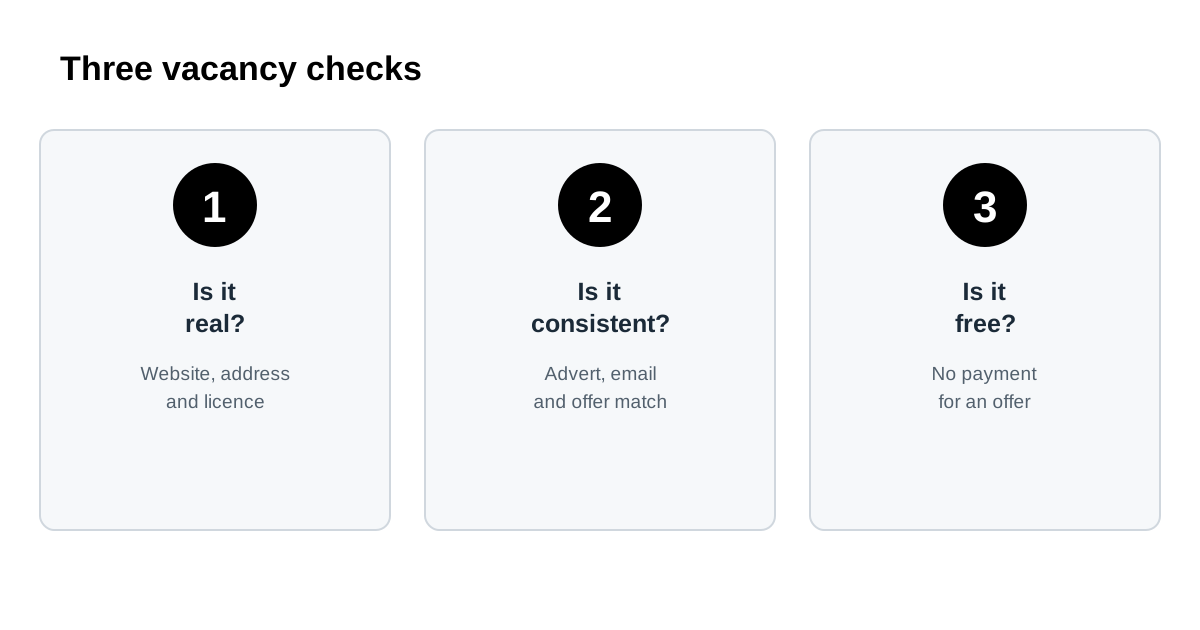
- The company has an official website and verifiable address.
- The advert names a real role and responsibilities.
- You are interviewed before an offer.
- No fee is requested at any stage.
- The email domain matches the company.
- The offer is written and consistent with what you were told.
If two or more points fail, stop and use our scam checker.
How to search without wasting weeks
Good searches are narrow. Choose one job title, one emirate and a few keywords from real adverts. Set up alerts on two or three reputable job boards and check the careers pages of 20 employers every week. Save each advert as a screenshot or PDF, because postings disappear and you will need the original wording for interviews.
Reading an advert like a recruiter
A genuine advert names the company, the role, the location, the main duties and the required experience. Be cautious when it lists only a phone number, uses very vague phrases such as "urgent hiring, all nationalities", promises high pay for no experience, or tells you to message a personal account. Compare the advert on the job board with the same role on the company's own website. If it exists only on social media, treat it carefully.
Test the employer in ten minutes
- Search the company name plus the word "complaints" or "scam" and read several results, not just the first one.
- Check that the website domain, email domain and company name match.
- Look for a trade licence number, physical address and working landline.
- See whether current employees list the company on professional networks, and message one politely.
Keep a tracking sheet
Use a simple table with company, role, link, date applied, contact and result. After two weeks, review which adverts led to interviews. If most replies come from one type of company, focus there. This turns a stressful search into a measurable routine.
When a reply sounds too good
If you receive an instant offer without an interview, a request for money, or a message from a personal number, stop. Run it through our scam checker and read how to avoid recruitment scams.
Conclusion
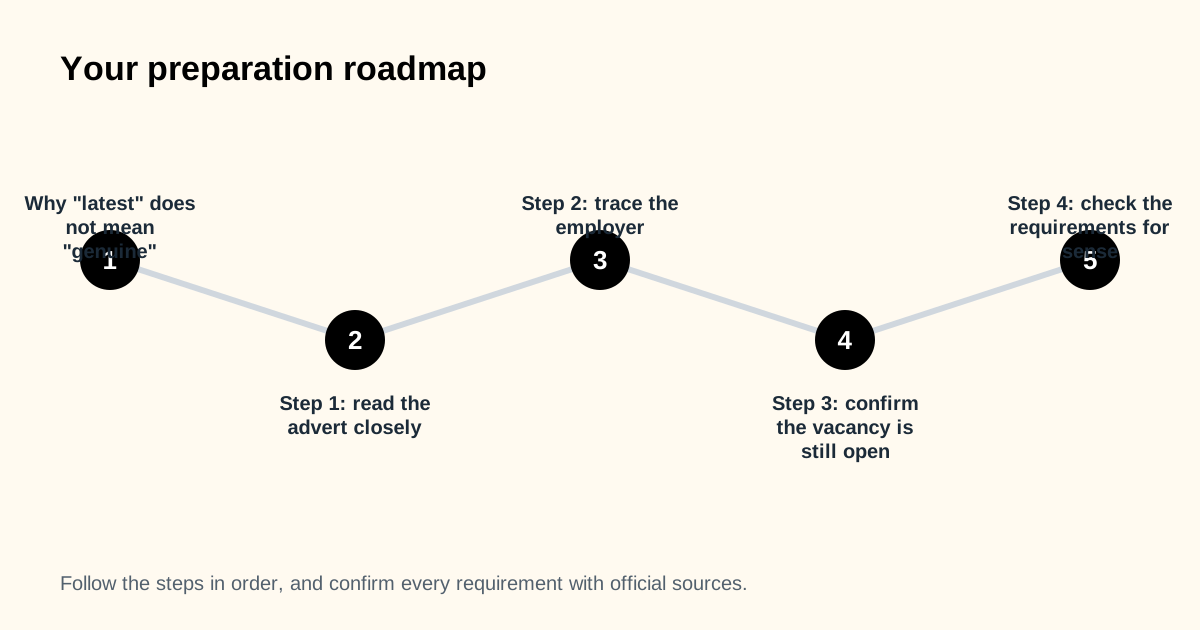
Identifying genuine vacancies is a skill you can learn. Read adverts closely, trace the employer through independent sources, confirm that the role is still open, check that the requirements make sense and watch how the application process works. When a vacancy touches on permits or contracts, confirm the rules on the UAE Government portal and with MOHRE instead of trusting the advert. A short, consistent checking routine saves time and protects both your money and your hopes.
Following up politely
If you do not hear back in a week, send a short email: thank them, restate the role and ask if the position is still open. Send one follow-up only. If the employer is real, a courteous message is welcome, and if it is fake, its response often reveals problems.
Frequently asked questions
How can I tell if a vacancy is old?
Check the posting date and the company careers page. If it is missing there, ask the employer directly.
Are job boards safe?
They are useful but can carry misleading adverts. Verify the employer before sharing documents.
Should I trust a recruiter on social media?
Treat them as unverified until you confirm the agency and the employer independently.