Sales Jobs in the UAE: Skills, Targets, and Interview Preparation
Sales is one of the most common ways into a business career in the UAE. Retail shops, car showrooms, real estate firms, telecom providers, hotels, insurance brokers and trading companies all employ salespeople, and many managers began on the shop floor or the phone. The field attracts people because performance can be visible and rewarded, but it also attracts misleading advertisements that promise unrealistic earnings. This guide explains the main kinds of sales roles, how targets and incentives generally work, which skills matter, how to prepare for interviews and how to check an offer before you accept it.
It does not state salary or commission figures and cannot predict results. Pay structures vary widely, so always get the terms in writing.
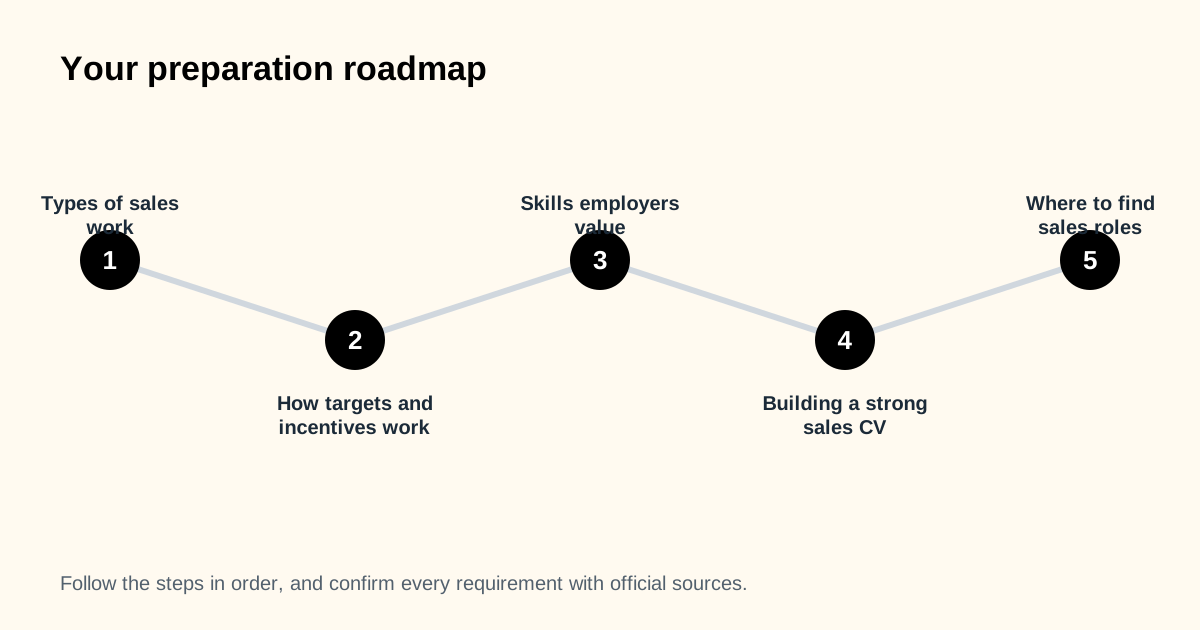
Types of sales work
Sales jobs differ in rhythm, customer type and pressure, so choose the kind that suits you.
Retail and showroom sales
Retail salespeople help customers in shops, malls and showrooms. The work involves product knowledge, customer service, stock awareness and handling payments. Targets may be set per shift, week or month.
Business-to-business sales
B2B salespeople sell to companies. They research prospects, arrange meetings, present solutions and negotiate contracts. Cycles are longer, relationships matter, and written and presentation skills are valuable.
Telesales and inside sales
Inside sales teams work by phone and online. They contact leads, explain products and book appointments or close sales. The role requires resilience, clear speech and good record keeping.
Field and territory sales
Field salespeople visit shops, offices or sites in a defined area. They manage visits, orders and relationships, and often use a vehicle. Time management and local knowledge are important.
Real estate, automotive and financial products
These sectors often have specific regulatory and licensing requirements and may involve commission-heavy pay. Candidates should verify which licences or permits are needed and which authority issues them, and should avoid paying anyone who offers shortcuts.
How targets and incentives work
A sales target is a measurable goal, such as monthly revenue, number of units or new accounts. Incentives can be structured in several ways: a fixed salary with a bonus for meeting targets, a lower fixed salary with commission, or commission-based pay. Each has advantages and risks. A fixed salary provides stability, while commission can reward strong performance but may lead to uncertain income.
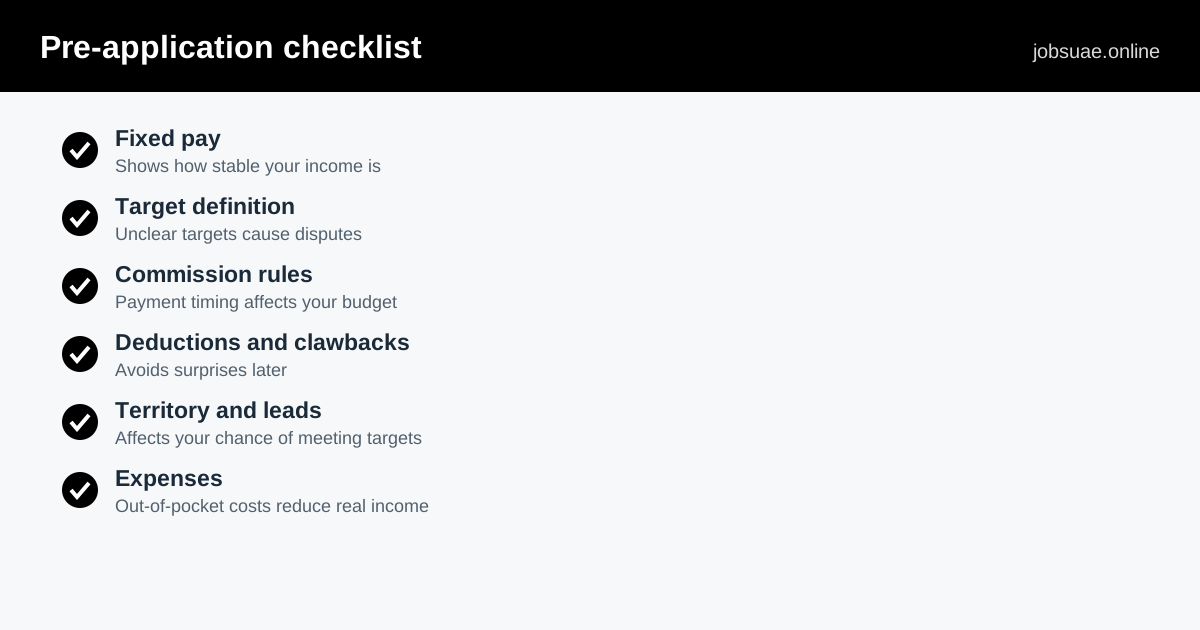
The table below shows questions to ask about any incentive plan. It is a checklist, not a statement of what employers offer.
| Topic | What to ask | Why it matters |
|---|---|---|
| Fixed pay | Is there a guaranteed basic salary, and how much of the package is fixed? | Shows how stable your income is |
| Target definition | How is the target set, measured and reviewed? | Unclear targets cause disputes |
| Commission rules | When is commission earned and when is it paid? | Payment timing affects your budget |
| Deductions and clawbacks | Can commission be reduced if a customer cancels or does not pay? | Avoids surprises later |
| Territory and leads | Who provides leads, and are territories protected? | Affects your chance of meeting targets |
| Expenses | Are travel, fuel and phone costs covered? | Out-of-pocket costs reduce real income |
| Written terms | Is the plan part of the contract or a separate document? | Written terms protect both sides |
Skills employers value
Successful salespeople are not necessarily the loudest. Employers look for good listening, honest communication, product knowledge, persistence, organisation and the ability to handle rejection. Cultural awareness is important in a market where customers come from many backgrounds, and a respectful approach is valued everywhere. Languages help, especially English plus Arabic or another widely used language, but clarity matters more than accent.
Basic digital skills are increasingly important. Many teams use customer relationship management software to record contacts and follow-ups, and spreadsheets to track targets. If you can show that you keep careful records, you stand out.
Building a strong sales CV
A sales CV should show results truthfully. Instead of "good at sales", write what you sold, to whom and with what outcome, if you can state it accurately: "Sold mobile accounts to walk-in customers in a mall store and met monthly targets in most months." Avoid inventing numbers, because employers often check references. If you are new to sales, use examples from customer service, volunteering or part-time work.
Include languages, software skills, licences relevant to the sector and your availability. If your CV needs work, start with our guide to writing a UAE-style CV.
Where to find sales roles
Employer career pages and reputable job boards list many sales positions, and licensed recruitment agencies place salespeople too. Search by industry and by company, and compare several adverts to understand normal expectations. If you are building a search plan, our practical Dubai job-search guide will help.
Be careful with adverts that promise very high earnings with no experience, that hide the company's name or that ask you to pay for training materials, starter kits or "registration". Some schemes require recruits to buy products or recruit others, which is not a normal employment arrangement. Our guide to avoiding recruitment scams explains warning signs.
Interview preparation
Sales interviews often include role-play. You may be asked to sell a pen, handle an objection or call a mock customer. The best approach is to ask questions first, understand the customer's needs and then connect features to those needs. Practise explaining a product simply, and prepare an example of a difficult customer and how you handled it.
Expect questions about targets: how you handled pressure, what you did when you missed a goal and how you organise your week. Honest answers are better than perfect ones. Prepare questions for the employer about training, leads, targets, product range, team structure and promotion paths.
Ethics and customer trust
Sales depends on trust. Making false claims, hiding fees, pressuring vulnerable customers or promising results you cannot deliver damages your reputation and can have legal consequences. Follow the company's policies and applicable consumer rules, and if you are asked to mislead customers, the safest course is to refuse and raise it with a manager. A reputation for honesty is the most durable sales asset.
Contracts and conditions
Before accepting an offer, check the job title, basic salary, commission or bonus plan, working hours, days off, probation, notice period and expense policy. Ask whether the target and incentive plan are in writing. Confirm who arranges permits and whether any fees are charged to you, which should raise concern. The u.ae portal and MOHRE are the places to check contract and permit rules before you sign.
Career paths in sales
Salespeople can progress to senior sales, team leader, sales manager, account manager, business development or regional roles. Others move into marketing, customer success, training or general management. To grow, track your results, ask for feedback, learn the product deeply and build relationships inside and outside the company.
Planning your week as a salesperson
Good salespeople manage time deliberately. A simple weekly structure helps: spend the start of the week planning calls and visits, reserve fixed blocks for prospecting, and keep time at the end for follow-ups and record keeping. Track the number of contacts, meetings and closed sales, because these figures show where your process leaks. If many conversations start but few end in a decision, the issue may be your questions or your follow-up rather than the product.
Review your results weekly, note which messages worked and which objections were most common, and prepare honest answers. Sharing useful findings with colleagues builds trust and often leads to better support from managers.
Handling objections and rejection
Rejection is part of sales, and how you respond to it shapes your career. Most objections fall into a few groups: price, timing, trust and need. Treat each as information. If the customer says the price is high, ask what they are comparing it with and explain value truthfully, without inventing discounts you cannot give. If they say they need time, agree on a specific follow-up date. If they do not trust you yet, offer clear information and let them decide.
Keep perspective after a bad day. Take notes, learn from the call and return to the next customer with a clear mind. Employers value people who recover quickly and stay professional.
Mistakes sales candidates often make
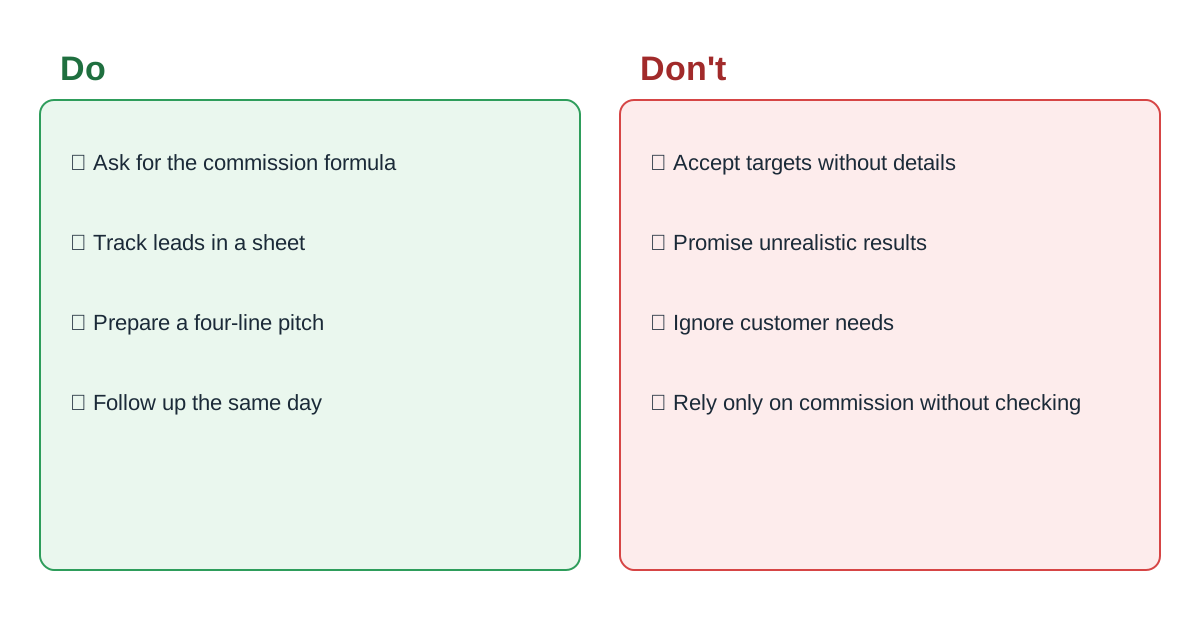
Some candidates accept commission-only roles without understanding the risk. Others overstate their results and are caught at reference checks. Some ignore the importance of follow-up and lose customers. A few pay for "training" that turns out to be a way to make them buy products. To avoid these problems, ask detailed questions, be honest, keep records and verify the employer.
Understand how you will be paid
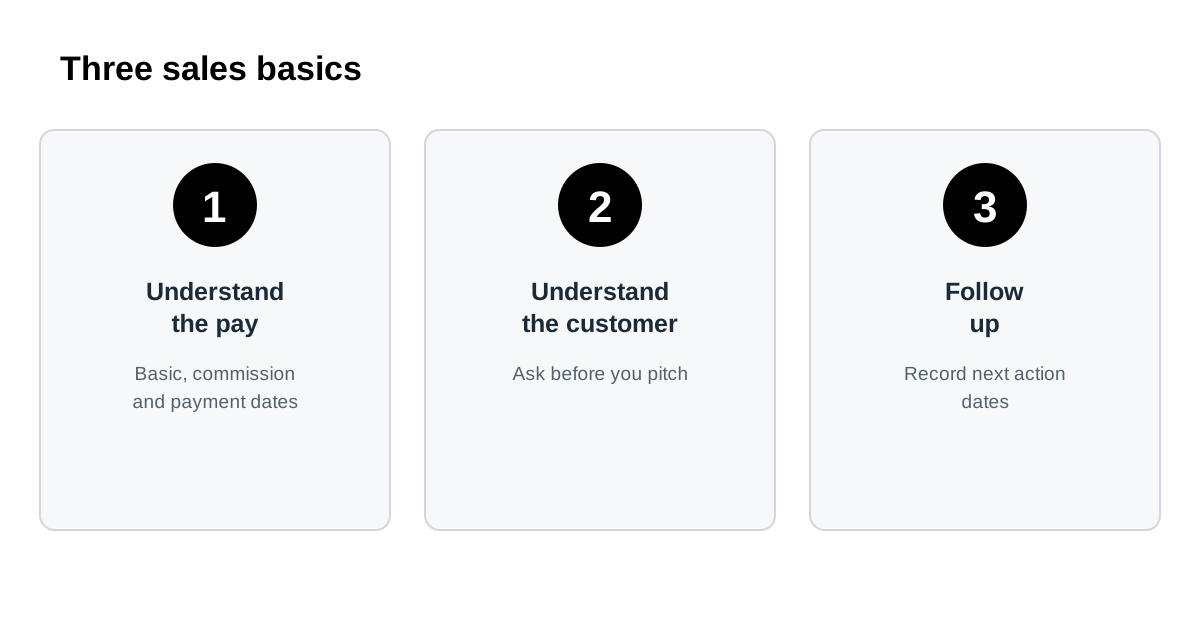
Sales offers often mix a basic salary with commission. Ask for the commission formula, targets, payment dates and what happens if a client cancels. Be careful with roles where the basic pay is very low and the earnings depend entirely on targets. Prepare a short pitch using a product you know well, since many interviews include a role-play.
Build a simple pitch and follow-up routine
A good pitch has four lines: the customer's problem, your solution, one proof point and a clear next step. Practise it for a product you know. After every meeting, send a short follow-up the same day and record the next action date in a sheet. Interviewers value candidates who track leads, because it shows discipline beyond charm.
Conclusion
Sales jobs in the UAE can offer growth for people who listen well, stay organised and act honestly. Understand the type of sales you want, learn how targets and incentives work, prepare a truthful CV and practise for interviews. Ask for the commission plan in writing and compare the contract with the guidance on MOHRE and the UAE Government portal. A careful, ethical approach protects your income and your reputation, and it is the best foundation for a lasting sales career.
A discovery conversation example
Instead of pitching immediately, ask: what are you using now, what problem is costing you time or money, and what would a good result look like? Then connect your product to their answer in two sentences. Customers buy when they feel understood, so listening is a core sales skill.
Dealing with rejection
Most sales conversations do not end in a sale. Treat each no as information: note the reason, adjust your pitch and move to the next lead. Keeping a simple record of objections helps you improve week by week.
Frequently asked questions
Is commission-only work common?
Some roles are mostly commission. Ask for the full structure in writing and compare it with the basic salary offered elsewhere.
Do I need a driving licence?
Field sales roles often do. Check the advert and ask about vehicle allowances.
How can I prove sales skills?
Use real numbers such as monthly volume, new clients or repeat orders, if you can verify them.