Accountant Jobs in the UAE: Qualifications, Software Skills, and Career Planning
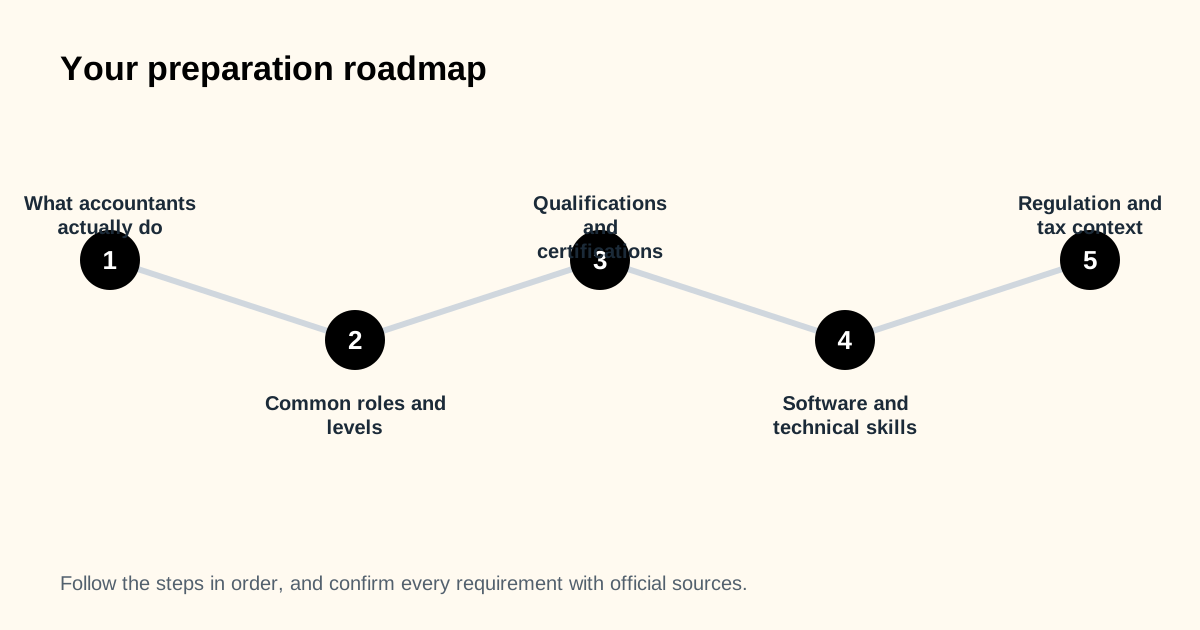
Every business in the UAE needs someone to record transactions, prepare reports, manage taxes and keep financial information accurate. That need makes accounting a stable profession, but it also means competition. Employers receive many applications that look alike, and candidates who understand what the job truly involves, and who present their skills clearly, stand out. This guide covers the main accounting roles, the qualifications and software employers often mention, how regulation shapes the work, and how to plan a career without relying on rumours or shortcuts.
It does not list vacancies, salaries or guaranteed outcomes. Requirements vary by company and can change, so confirm details with employers and official bodies.
What accountants actually do
Accounting is not only bookkeeping. Depending on the company's size, an accountant may record sales and purchases, reconcile bank statements, process payroll inputs, prepare monthly reports, handle supplier and customer accounts, support audits and manage tax filings. In a small trading firm, one person may do everything. In a large company, work is split among accounts payable, accounts receivable, general ledger, treasury, cost accounting, payroll and reporting teams.
Understanding this helps you choose where to start. A detail-oriented person who enjoys routine accuracy may suit accounts payable. Someone who likes analysis may prefer cost accounting or financial reporting.
Common roles and levels
Accounts assistant or clerk
Entry-level staff enter invoices, match documents, file records and respond to simple queries. Employers look for accuracy, basic spreadsheet knowledge and willingness to learn their system.
Junior and staff accountant
Junior accountants prepare reconciliations, post journal entries, assist with month-end closing and support supervisors. A degree or diploma in accounting or commerce is commonly requested, along with an understanding of accounting principles.
Senior accountant and accounting supervisor
Senior staff review work, prepare reports, support audits and manage deadlines. Several years of experience, strong software skills and the ability to explain figures are usually expected.
Finance manager and beyond
Finance managers oversee teams, budgets, cash flow and compliance, and they communicate with management and auditors. This level usually combines experience with professional certification and leadership skills.
Qualifications and certifications
Employers commonly ask for a bachelor's degree or diploma in accounting, finance or a related field. Professional certifications can strengthen an application, especially for more senior roles. Recognised international qualifications are often mentioned in adverts, and your choice should depend on your career goals and the employers you are targeting.
Before you invest time and money in a course, check three things: whether the awarding body is genuine, whether employers in your target field mention it, and what the exam and experience requirements are. Avoid providers who promise guaranteed jobs or exam success. If your degree was earned abroad, ask the employer how it will be verified, and check current requirements for attestation or equivalency rather than trusting an agent.
Software and technical skills
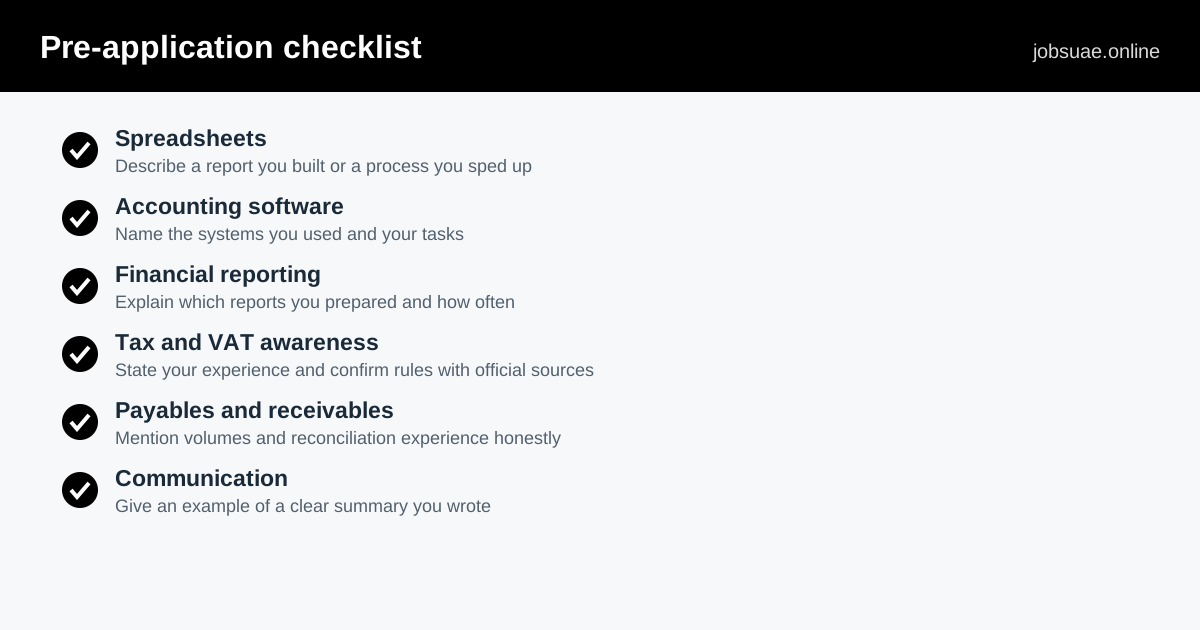
Employers care about practical skills as much as titles. The table below shows common skill areas and how to demonstrate them. It is a general guide, and each employer uses its own tools.
| Skill area | What it involves | How to show it |
|---|---|---|
| Spreadsheets | Formulas, lookups, pivot tables, reconciliations | Describe a report you built or a process you sped up |
| Accounting software | Recording transactions and producing reports in a system | Name the systems you used and your tasks |
| Financial reporting | Trial balance, profit and loss, balance sheet | Explain which reports you prepared and how often |
| Tax and VAT awareness | Understanding how VAT and corporate tax affect records | State your experience and confirm rules with official sources |
| Payables and receivables | Invoices, payments, follow-up, ageing reports | Mention volumes and reconciliation experience honestly |
| Communication | Explaining numbers to non-accountants | Give an example of a clear summary you wrote |
Regulation and tax context
The UAE has introduced value added tax and corporate tax in recent years, and businesses are required to follow the rules set by the federal authorities. For accountants this means records, invoices and filings must be accurate and timely. The Federal Tax Authority publishes official guidance, and companies often rely on accountants to apply it.
Because tax rules are updated, do not rely on a blog or a forum post for current rates, thresholds or deadlines. Read the official guidance on the UAE Government portal and the Federal Tax Authority website, and be open about the limits of your knowledge in an interview. Saying "I follow the official guidance and confirm details before filing" is a stronger answer than guessing.
Preparing your CV
Accounting CVs should be clean and exact, since errors undermine credibility. Lead with a short summary stating your job title, years of experience and main tools. Under each job, show what you handled, such as monthly reconciliations, supplier statements or VAT working papers, and the scale where you can state it truthfully. Avoid general phrases like "excellent accounting skills".
List software by name and your level, include relevant certifications with status, such as completed or in progress, and keep formatting simple, because an applicant tracking system may read the file. If your CV needs work, start with our guide to writing a UAE-style CV.
Where to look and how to apply
Search employer career pages in industries such as trading, retail, real estate, hospitality, logistics and construction, because each needs finance staff. Professional networks and reputable job boards can help, and licensed recruitment agencies place many accountants. As with any role, be careful with offers that ask for a fee or request sensitive documents too early, and read our guide to avoiding recruitment scams. A broader search plan appears in our guide to finding jobs in Dubai.
Interview preparation
Interviewers often test fundamentals, so review basic accounting principles, reconciliations, accruals and the difference between profit and cash flow. You may be asked to explain how you would find an error in a ledger, handle a late supplier invoice or prepare for month-end. Many employers include a practical spreadsheet or software test.
Prepare examples of accuracy under pressure, such as catching a duplicate payment or fixing a reconciliation. Be honest about what you have not done and show willingness to learn. Ask about the systems, reporting calendar, team structure and training.
Mistakes accounting candidates often make that hold candidates back
Several patterns appear again and again in accounting applications. Some candidates list every software package they have ever opened, then struggle when asked a simple practical question about it. Others describe duties without any measure of scale, so the reader cannot tell whether they handled ten invoices a week or a thousand. Some leave unexplained gaps or inconsistent dates, which raises doubts in a profession built on accuracy. Another common weakness is poor spreadsheet control: broken formulas, unlabelled sheets and inconsistent formatting suggest carelessness.
A better approach is to choose three or four tools you know well, state clearly what you did with each, and bring a clean sample task if the employer allows it. Check your own documents twice before sending them.
Working across different industries
The same skills apply across sectors, but each industry adds its own flavour. In trading companies, accountants spend more time on inventory, supplier balances and customs-related costs. In hospitality, daily revenue reports and outlet-level costs matter. In construction, project costing, progress billing and retention accounting are central. In retail, the volume of small transactions and stock reconciliations dominates. Reading an employer's business model before the interview helps you ask relevant questions and explain how your experience fits.
Ethics and professional conduct
Accountants handle sensitive information and are expected to be honest even when pressured. If you are asked to alter records, delay reporting improperly or hide a mistake, the safest course is to refuse, document the request and escalate through proper channels. A career in accounting depends on trust, and a reputation for integrity lasts longer than any single job.
Planning your growth
Think in stages. In the first two years, master the basics, learn the software well and ask for exposure to month-end closing. In the next phase, take on reporting, audit support or tax tasks, and consider a recognised certification aligned with your goals. Later, develop leadership, budgeting and communication skills. Keep a log of achievements, such as processes improved or deadlines met, to use in future applications and reviews.
Skills that separate shortlisted accountants
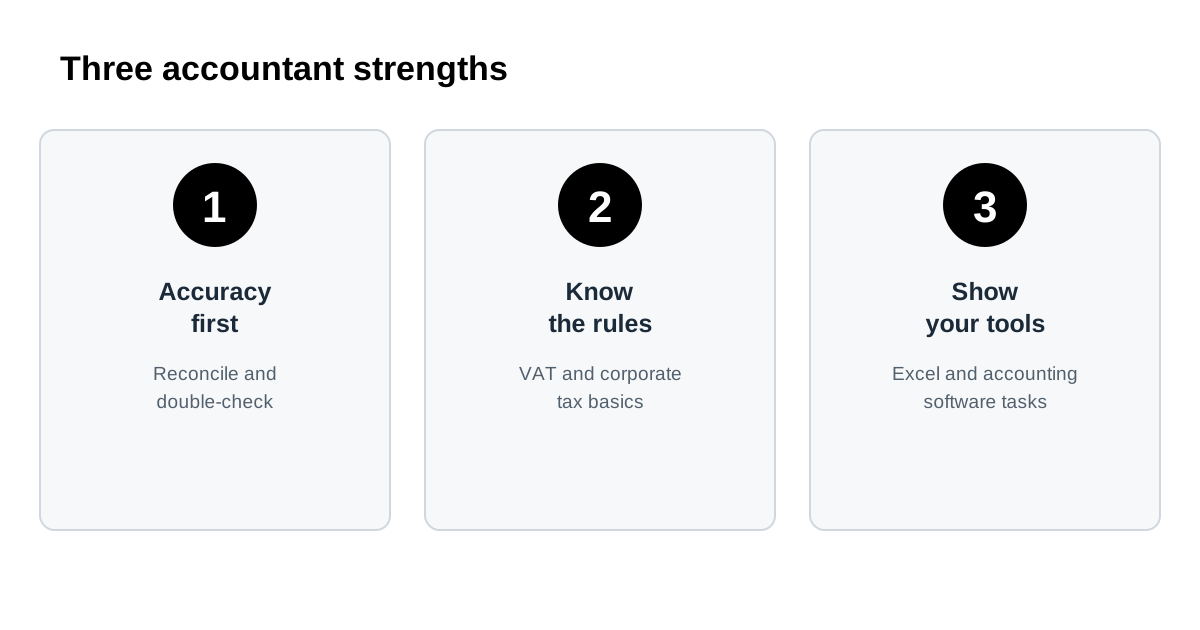
Most UAE employers expect solid bookkeeping, month-end closing and reconciliations. Beyond that, two topics come up often: VAT, which the Federal Tax Authority administers, and corporate tax, introduced for businesses in recent years. You do not need to be a tax specialist for every role, but you should explain in simple words how input and output VAT work and where filing deadlines are published. Check the Federal Tax Authority website for current rules instead of relying on old posts.
Prove your software skills
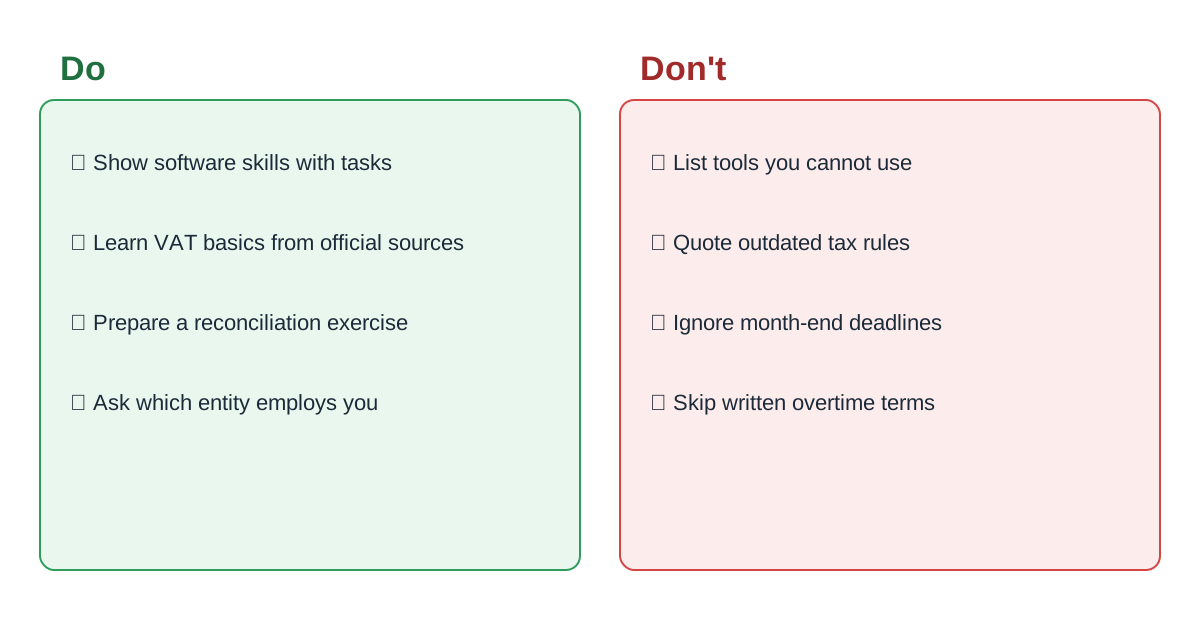
Instead of writing "good with accounting software", name the tools and what you did in them: posting journals, running aged receivables, preparing a trial balance or building a pivot table. Common tools include Excel, Tally, QuickBooks and Zoho Books. Prepare a small practice exercise, such as reconciling a bank statement, because many employers run a short test.
Questions to ask before accepting
Ask which entity you would work for, who you report to, and how month-end deadlines are handled. Clarify whether overtime at quarter-end is paid or compensated.
Conclusion
Accounting jobs in the UAE reward accuracy, curiosity and integrity. Understand the roles, build real software skills, check qualifications carefully, and follow official guidance on tax and regulation. Prepare a clear CV, practise interview basics, and read every contract and offer before you sign. For tax and VAT questions, rely on the Federal Tax Authority, and use the UAE Government portal and MOHRE for employment and contract rules. Steady skill-building is the most dependable way to progress in this field.
A sample practical test and how to approach it
An employer gives you a bank statement and a ledger and asks you to reconcile them in 30 minutes. Start by matching obvious items, list unmatched entries in two groups, check timing differences, then explain remaining differences in a short note. Speak or write your reasoning clearly. Employers often value a tidy method more than a perfect score.
Growing beyond bookkeeping
Accountants can move into analysis, audit support, tax compliance or finance management. Choose one direction, take a relevant course from a recognised provider and add small projects to your CV, such as a budget model or a month-end checklist.
Frequently asked questions
Do I need a certification?
Requirements vary. Degrees and recognised professional qualifications help, but many employers also test practical skills.
Is VAT knowledge necessary?
For many roles yes, at least the basics. Check the Federal Tax Authority website for current rules.
What tests do employers give?
Common tests include bank reconciliation, journal entries and Excel tasks. Practise under time pressure.