Airport Jobs in the UAE: Roles, Eligibility, and Official Application Channels
Airports are small cities. In the UAE, the main airports in Dubai and Abu Dhabi handle millions of passengers, thousands of flights and enormous volumes of cargo, and they depend on a wide range of workers: check-in agents, baggage handlers, security officers, engineers, retail staff, cleaners, drivers, customer service teams and managers. Because the sector is high-profile, it is also a favourite subject for scammers who promise "airport visas" and "guaranteed jobs" for a fee. This guide explains who actually employs airport staff, what roles exist, what screening is involved and how to apply through channels you can verify.
It does not list vacancies or promise that any employer is recruiting. Recruitment changes with the season and the market, so treat this as preparation.
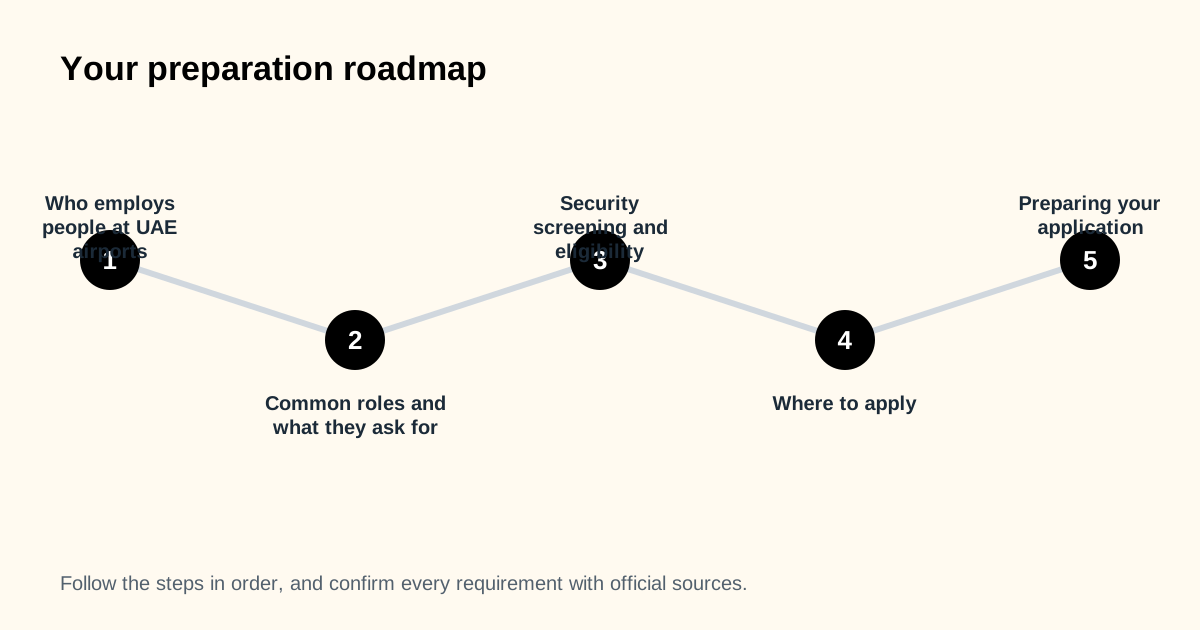
Who employs people at UAE airports
An airport does not have a single employer. Several types of organisation operate side by side, and each recruits separately.
Airport operators
Operators manage terminals, runways and infrastructure. In Dubai, airports are operated by Dubai Airports, and in Abu Dhabi the airport operator is Abu Dhabi Airports. They hire for operations, customer experience, safety, engineering, facilities and administration, and they publish roles through their own career pages.
Airlines
Airlines hire cabin crew, pilots, engineers, ground staff, ticketing and reservations teams and many support roles. Large carriers publish their openings on their official websites and sometimes hold recruitment events. Always check that an event is announced on the airline's own channels.
Ground handling and cargo companies
Ground handlers load baggage, marshal aircraft, manage cargo and support catering. Cargo companies handle freight, customs documents and warehouse operations. These organisations often hire large numbers of operational staff, and some roles resemble warehouse or driving work. Our guide to warehouse helper jobs explains the skills that transfer.
Retail, food and service operators
Shops, restaurants, lounges and service desks inside terminals are run by companies that hire their own staff. These jobs resemble retail and hospitality roles but follow airport access rules.
Security, cleaning and facilities contractors
Security services and facilities companies provide guards, cleaners and technicians. Security roles are regulated, as explained in our guide to security guard jobs.
Common roles and what they ask for
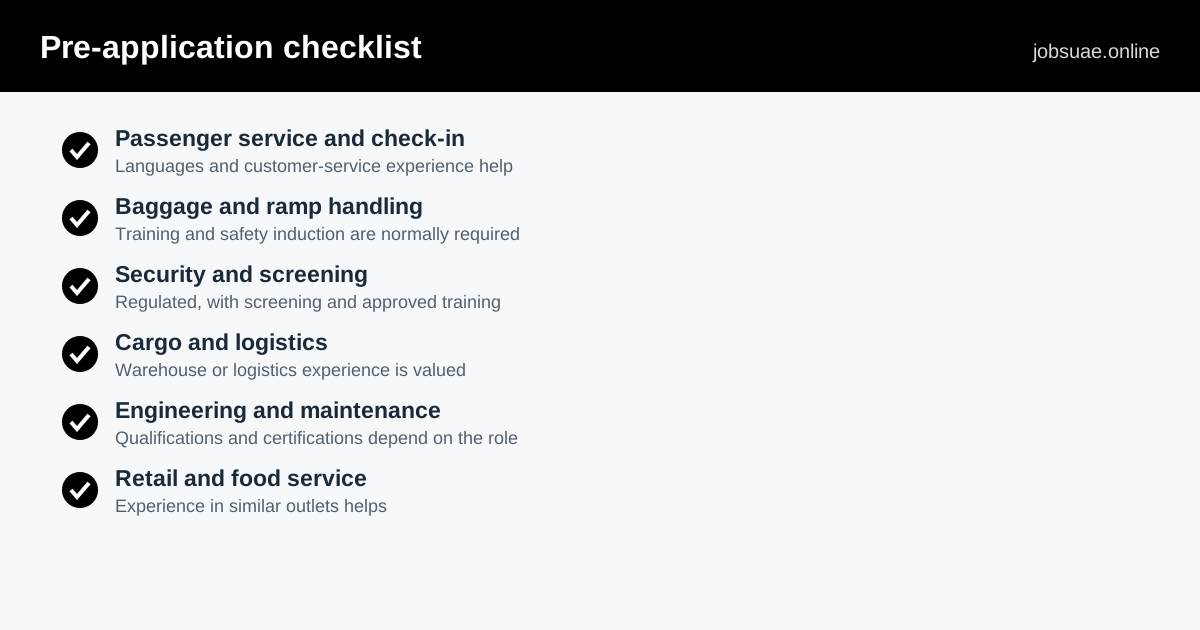
The table below summarises typical airport roles. It is general guidance and does not describe any specific vacancy.
| Role area | Core skills | Entry considerations |
|---|---|---|
| Passenger service and check-in | Communication, systems, calm under pressure | Languages and customer-service experience help |
| Baggage and ramp handling | Fitness, safety discipline, teamwork | Training and safety induction are normally required |
| Security and screening | Observation, procedure, integrity | Regulated, with screening and approved training |
| Cargo and logistics | Accuracy, documentation, equipment skills | Warehouse or logistics experience is valued |
| Engineering and maintenance | Technical trade skills, safety | Qualifications and certifications depend on the role |
| Retail and food service | Sales and service skills, hygiene | Experience in similar outlets helps |
| Cleaning and facilities | Reliability, standards, stamina | Shift work and site access rules apply |
| Administration and management | Planning, software, leadership | Degrees and experience are often requested |
Security screening and eligibility
Airports are secure environments, and people working in restricted areas must be screened and authorised. The details are set by the relevant authorities and employers, and they can change. In general, staff may need to provide identity documents, pass background checks and complete security awareness training before receiving an airport access pass. Some roles also require medical checks or specific certificates.
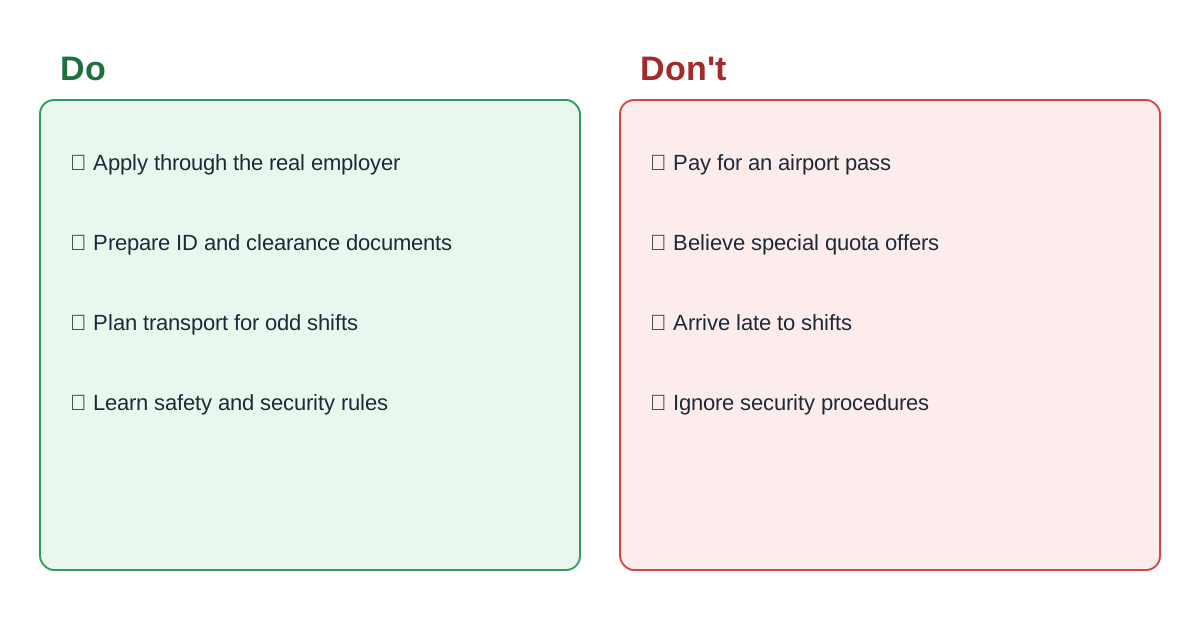
Practically, this means that hiring can take time after an offer, and that an offer may be conditional on clearance. Be honest on every form, because inaccurate information can lead to rejection or dismissal. Do not pay anyone for an "airport pass" or "security clearance", because these are processed through official channels, usually arranged by the employer.
Where to apply
Start with official career pages: the airport operators, airlines, ground handlers and major service companies each publish their own. Check the web address carefully, and compare it with the company's main website. Reputable job boards and licensed recruitment agencies may also list roles, but confirm the employer's name and the application route.
Be cautious with social media posts that claim "urgent airport hiring" and ask you to message a personal number. Our guide to avoiding recruitment scams explains how to test an offer, and our guide to finding jobs in Dubai explains how to keep a tracking sheet.
Preparing your application
Choose the role that fits your background and prepare a CV for it. For passenger service, emphasise languages, customer contact and systems. For operational roles, describe your physical work experience, safety habits and shift flexibility. For technical roles, list qualifications, certificates and equipment. For administration, emphasise software and process experience. A step-by-step layout is in our UAE-style CV guide.
Prepare identity documents and certificates, but share them only with verified employers and at the stage requested. Keep your phone number and email active, because recruiters often move quickly.
Interviews and assessments
Airport recruitment can include several stages: an online application, an assessment, an interview and sometimes a group exercise or practical test. For customer-facing roles, you may be asked how you would help a distressed passenger or handle a long queue. Good answers show empathy, clear communication and procedure. For operational roles, safety and teamwork questions are common, such as what you would do if you noticed an unsafe practice. For technical roles, expect questions about your trade and tests of knowledge.
Prepare questions about shift patterns, training, transport to the airport, access rules and progression. Airports operate around the clock, so ask clearly about night shifts and rotating schedules.
Working life at an airport
Airport work is shift-based and often involves early starts, nights, weekends and holidays. Teams are multicultural, and communication across languages is routine. Peak travel periods can bring heavy workloads, and safety and punctuality are critical. Heat affects outdoor work, so protective equipment and hydration are part of the job. Many people enjoy the pace and variety, but it suits those who stay calm and flexible.
Commuting is a practical issue. Airports are often far from residential areas, so ask whether transport is provided and how long the journey is. These factors affect your real quality of life more than small salary differences.
Contracts and conditions
Check your offer carefully. Confirm the job title, employer, salary, allowances, working hours, rest days, overtime terms, probation and notice period. Ask whether the offer is conditional on security clearance and what happens if clearance is delayed. Find out whether accommodation or transport is provided and who pays for training and uniforms. Do not pay a fee for a job. For official guidance on contracts and permits, consult MOHRE and the UAE Government portal.
Career paths
Airport careers can move in many directions. A passenger agent can become a supervisor or station manager. A ramp worker can progress to team leader or safety officer. Cargo staff can move into planning or customs coordination. Technical workers can move into specialist or supervisory roles. Building skills in safety, systems and communication helps in every track.
A day on the job: three examples
Examples show how different the work can be. A passenger service agent starts with a briefing on the day's flights, then helps travellers at the counter, solves problems such as missing documents or changed bookings, and records issues for the next shift. A ramp team member attends a safety briefing, puts on protective equipment, and helps load or unload baggage and cargo according to the flight schedule, always following instructions and staying clear of moving vehicles. A cargo clerk checks shipping documents against the freight, flags discrepancies and updates the system so that the right goods reach the right aircraft.
In all three cases, accuracy, punctuality and communication are what supervisors notice. Employers look for people who follow procedures even when the work is busy.
Language and communication
Airports bring together passengers and colleagues from many countries, so communication is a daily skill. English is widely used in operations, and Arabic or other languages can help in customer-facing roles. Clear, polite speech, attention to tone and the ability to stay calm with frustrated passengers matter more than perfect grammar. If you want to improve, practise speaking aloud, learn common travel vocabulary and role-play difficult situations with a friend.
Mistakes airport applicants often make
Some applicants rely on rumours of mass recruitment and miss official announcements. Others send applications without checking whether the role requires clearance or a specific certificate. Some pay agents for guaranteed placement. A few overlook shift and commute realities and later struggle to stay in the job. To avoid these problems, use official channels, read advert requirements, be honest in applications and ask practical questions.
Understanding who actually hires
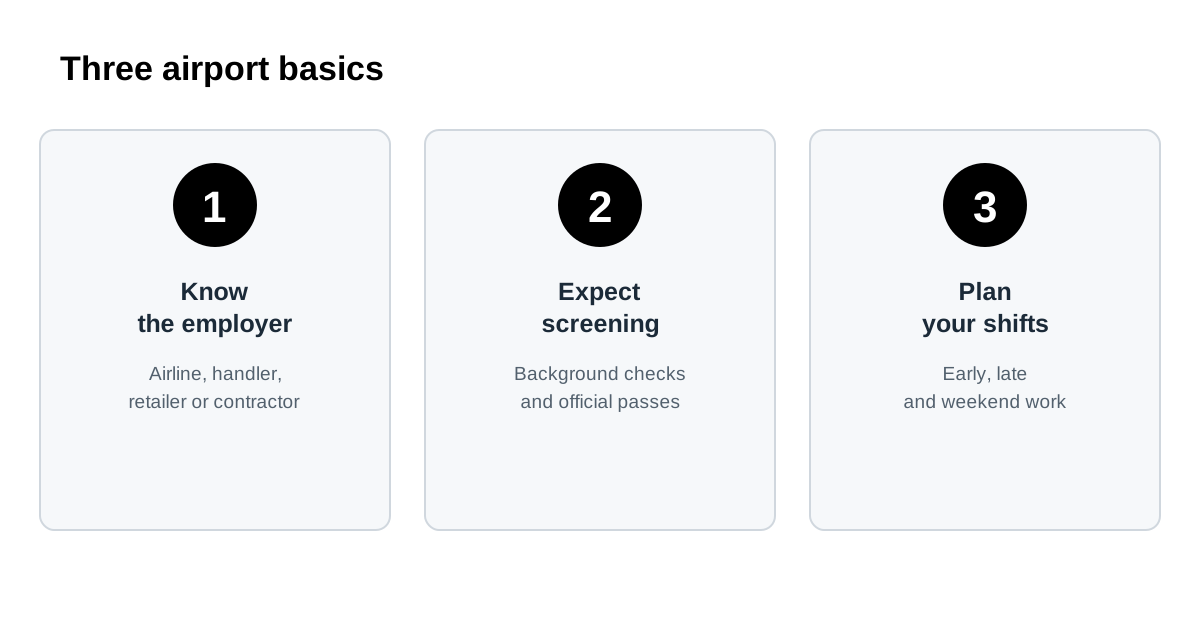
Airport jobs are rarely hired by "the airport" directly. Airlines, ground handlers, catering firms, cargo companies, retail operators and security contractors each run their own recruitment. Apply through the company's official careers page, and be cautious about messages claiming that a "special airport quota" requires a fee.
Screening and shift reality
Working in secured areas normally requires background checks, identity documents and an airport pass issued through the official process. Expect some roles to involve rotating shifts, early mornings, nights and weekends, and plan your transport accordingly. Ask during interview how a late arrival or missed shift is handled, because airport schedules are strict.
Skills worth building
Customer-facing roles value clear English, calm handling of delays and basic knowledge of luggage and boarding procedures. Physical roles value safe lifting and attention to safety rules. Mention any first aid or safety training you have completed.
Conclusion
Airport jobs in the UAE offer variety and structure, but they are recruited through many different employers and involve screening and shift work. Learn who employs the roles you want, prepare an honest application, use official channels and read every contract before accepting. Apply through official career pages, confirm general employment rules on the UAE Government portal and with MOHRE, and never pay for an airport pass. Careful preparation shows employers that you understand the seriousness of working in a secure, round-the-clock environment.
Case example: a missed shift and what it teaches
A new baggage handler lives far from the airport and relies on a shared ride. One morning the ride is late and he reports forty minutes after the start. His supervisor explains that flights cannot wait, and a late arrival delays the whole team. He then arranges a backup transport option and leaves home earlier. Employers notice exactly this kind of reliability, so plan your commute before you accept a roster.
Career steps inside an airport
Staff often begin in support roles and move toward supervisor, ramp, passenger service or operations roles. Training in safety, first aid or customer service helps, as does a record of punctuality. Keep copies of training certificates and ask your employer which courses are recognised.
Frequently asked questions
Who hires airport staff?
Airlines, ground handlers, catering, cargo, retail and security contractors each hire for their own roles. Use their official careers pages.
Do airport jobs need background checks?
Roles in secured areas normally involve checks and an official pass. Confirm the process with the employer.
Are airport jobs always shift work?
Many are. Ask for a sample roster and transport details before accepting.